
How GISTM is Reshaping Tailings Governance in South America
//: # (meta: The Global Industry Standard on Tailings Management (GISTM) is transforming how South American mining companies approach safety, transparency, and accountability. Explore how Brazil, Chile, and Peru are adapting — and what this means for the future of tailings governance in the region.)
How GISTM is Reshaping Tailings Governance in South America
Introduction — the epicenter of a global shift
When the Global Industry Standard on Tailings Management (GISTM) was introduced in 2020, it marked a turning point for the global mining industry.
Nowhere, however, has its impact been more visible than in South America — a region home to hundreds of tailings storage facilities (TSFs), some among the largest and most consequential in the world.
Brazil’s Brumadinho disaster (2019) became the tragic catalyst for the creation of GISTM. Yet, five years later, that same region is now leading the world in adopting and operationalizing the standard.
From the Andes to the Amazon, mining regulators, operators, and investors are reshaping governance frameworks to align with GISTM’s vision of zero harm, full accountability, and total transparency.
- The GISTM framework — a recap
GISTM, developed jointly by the International Council on Mining and Metals (ICMM), the UN Environment Programme (UNEP), and the Principles for Responsible Investment (PRI), defines 15 principles across six areas:
Affected communities
Integrated knowledge base
Design, construction, operation, and monitoring
Management and governance
Emergency response and recovery
Public disclosure and transparency
Its purpose is simple but ambitious: to ensure zero fatalities and zero long-term environmental harm from tailings facility failures.
But GISTM is not a “technical manual.” It’s a governance revolution, embedding ESG principles — ethics, accountability, and transparency — into every layer of decision-making.
- Why South America is central to GISTM implementation A region shaped by both tragedy and opportunity
South America holds over 40% of the world’s active tailings storage facilities, concentrated in mining powerhouses such as Brazil, Chile, and Peru. The region’s unique combination of:
Steep topography,
High rainfall,
Seismic activity, and
Socially dense downstream areas,
makes tailings risk particularly high.
The Mariana (2015) and Brumadinho (2019) disasters in Brazil exposed systemic flaws — weak governance, insufficient transparency, and a lack of independent oversight.
GISTM provided a roadmap for transforming those failures into reform. It’s no coincidence that South America became both the origin and proving ground for the new standard.
- Brazil — from tragedy to transformation Regulatory evolution
Brazil has been the most aggressive adopter of GISTM-aligned regulation. The National Mining Agency (ANM) responded to Brumadinho with sweeping reforms:
Resolution 13/2019 banned upstream tailings dams — the type that failed in Brumadinho.
Resolution 95/2022 established new technical safety parameters and emergency planning standards consistent with GISTM’s principles.
Mandatory risk classification systems now mirror GISTM’s consequence-based model (Extreme, Very High, High, etc.).
Corporate implementation
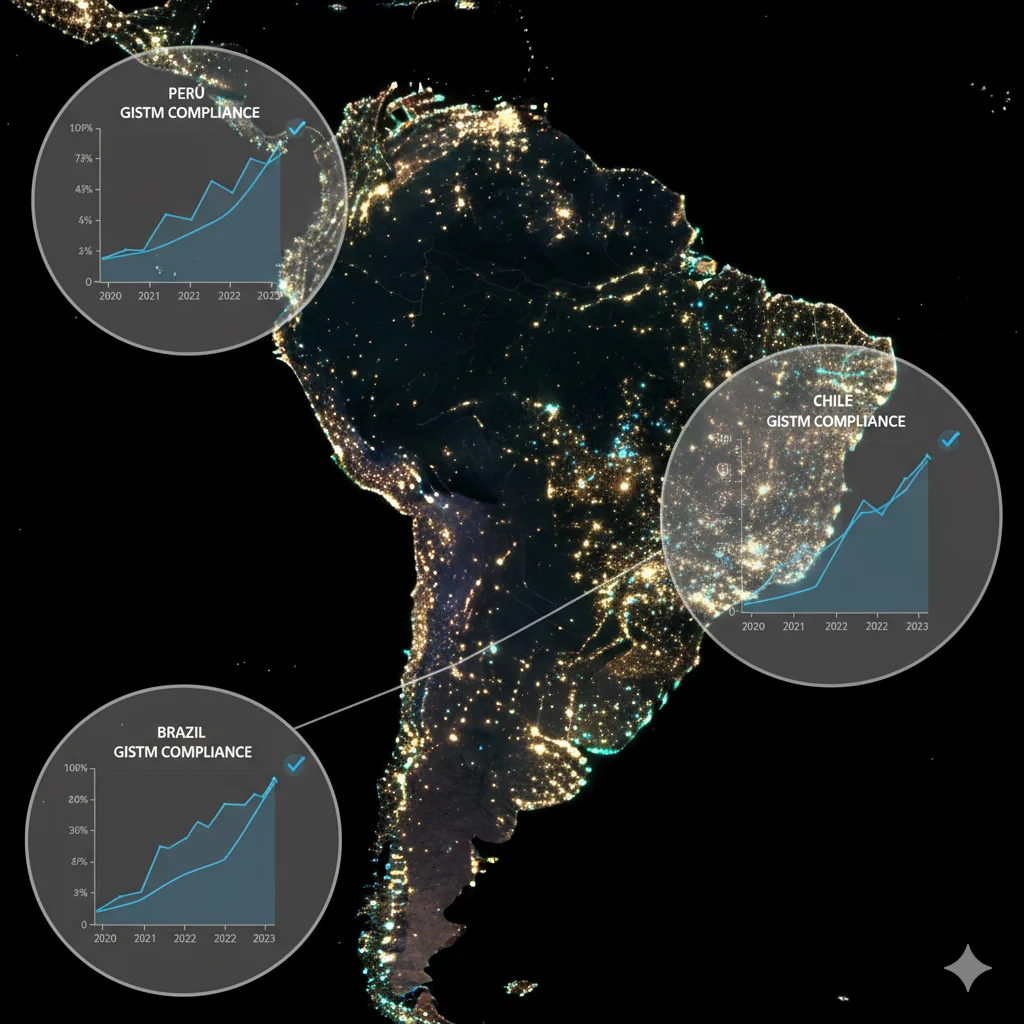
Vale, Anglo American, and Nexa Resources have committed to full GISTM compliance across all facilities by 2025, with Vale already declaring 100% of its high-consequence facilities conformant by 2023.
Vale’s corporate governance model now includes:
An Accountable Executive for each facility.
An Independent Review Board (IRB).
Public reporting aligned with ICMM’s disclosure framework.
Brazil has effectively become a living laboratory for GISTM in action — demonstrating how a nation can turn accountability reforms into corporate ESG value.
- Chile — integration through institutional strength A foundation of strong technical regulation
Chile’s mining sector already had robust tailings regulations before GISTM, notably Decree DS248, which governs the design, construction, operation, and closure of TSFs.
What’s new is how GISTM principles are being integrated into corporate governance and transparency frameworks:
Codelco established a corporate tailings oversight division reporting directly to the CEO.
Antofagasta Minerals has aligned its emergency preparedness plans with GISTM’s social engagement requirements.
The National Geology and Mining Service (SERNAGEOMIN) is collaborating with the ICMM to align audit and inspection protocols with GISTM.
Chile’s approach is more institutional and harmonized — adapting global principles to fit national standards rather than duplicating them.
- Peru — accelerating toward integrated governance A growing emphasis on transparency and ESG
Peru, another regional mining leader, is taking major steps toward GISTM alignment through new policy and data initiatives.
The Ministry of Energy and Mines (MINEM) has launched a review of tailings guidelines to incorporate GISTM-aligned governance, risk management, and disclosure requirements.
Mining companies such as Buenaventura and Southern Copper have adopted corporate tailings governance frameworks modeled on the 15 GISTM Principles.
Pilot programs for digital monitoring and real-time data sharing are underway in partnership with universities and NGOs.
Peru’s model emphasizes transparency and data integration — turning compliance into an opportunity for innovation.
- Beyond compliance — how GISTM is changing corporate culture
The biggest change isn’t just technical — it’s cultural. GISTM requires companies to:
Elevate tailings risk to the board level.
Integrate social engagement into operational planning.
Ensure independent oversight through Engineers of Record (EoR) and IRBs.
Commit to public disclosure of performance data.
These are not “optional extras.” They redefine how mining companies think about accountability.
In Brazil, for example, local communities near tailings dams now participate in emergency drills and risk communication sessions — a direct outcome of GISTM Principle 12.
This cultural shift is fostering trust, transparency, and shared responsibility — essential ingredients for long-term mining sustainability.
- Regional challenges — implementation is not uniform
Despite progress, challenges remain:
Cost and resource demands: Smaller operators struggle with the financial and technical burden of full GISTM compliance.
Data management gaps: Integrated knowledge bases (Principle 4) require digital systems that many sites lack.
Independent reviewer capacity: There’s a shortage of qualified Engineers of Record and IRB members in Latin America.
Regulatory overlap: Countries must align national standards with GISTM without creating redundancy.
Addressing these gaps requires regional collaboration, shared training programs, and capacity building — something ICMM and local mining associations are already working on.
- Opportunities — innovation, transparency, and ESG leadership
For all its challenges, GISTM implementation has spurred innovation across the region:
Digital twins and AI monitoring: Vale and Nexa now use predictive analytics to detect anomalies in dam stability.
Remote sensing and satellite monitoring: Chilean companies are using InSAR technology to provide continuous oversight.
Community engagement dashboards: Peruvian mines are experimenting with web-based platforms to share real-time safety updates.
By connecting technology with transparency, South America is demonstrating how GISTM can drive both compliance and modernization.
- Looking ahead — regional leadership in global governance
As the 2025 GISTM compliance deadline approaches for all facilities worldwide, South America’s experience is setting the benchmark for global mining governance.
What’s emerging is a regional model that:
Combines technical rigor with social accountability.
Balances local realities with global ESG expectations.
Uses transparency as a catalyst for rebuilding public trust.
This is no longer about avoiding failure — it’s about leading a transformation.
Conclusion — South America’s mining sector at a crossroads
The implementation of GISTM across Brazil, Chile, and Peru marks a new era for mining governance. What began as a response to tragedy has evolved into a comprehensive movement toward ethical, transparent, and technically sound tailings management.
South America is showing the world that compliance and competitiveness can coexist — that a region once synonymous with risk can become a global model for responsible mining.
GISTM isn’t just raising the bar — it’s changing the game.
Sources & further reading: Global Tailings Review; ANM Brazil resolutions; Chile DS248; MINEM Peru guidance.