
How the Global Industry Standard on Tailings Management (GISTM) Came to Be
//: # (meta: Discover the history and driving forces behind the Global Industry Standard on Tailings Management (GISTM), from catastrophic failures like Brumadinho to the international collaboration that reshaped mining governance.)
How the Global Industry Standard on Tailings Management (GISTM) Came to Be: The Story Behind the Standard
Introduction — why the world needed a new standard
The mining industry has always depended on tailings storage facilities (TSFs) — vast engineered structures designed to contain finely ground waste from mineral processing. For decades, these facilities were managed under national regulations and technical codes. But as mines grew larger and tailings volumes expanded, a troubling pattern of catastrophic failures began to emerge.
These weren’t isolated events — they were systemic. And each one carried a common message: the world needed a single, global framework to prevent such disasters.
The result was the Global Industry Standard on Tailings Management (GISTM) — launched in August 2020 — a direct response to public outcry, investor pressure, and an industry-wide reckoning with safety, governance, and accountability.
The tragedies that triggered change
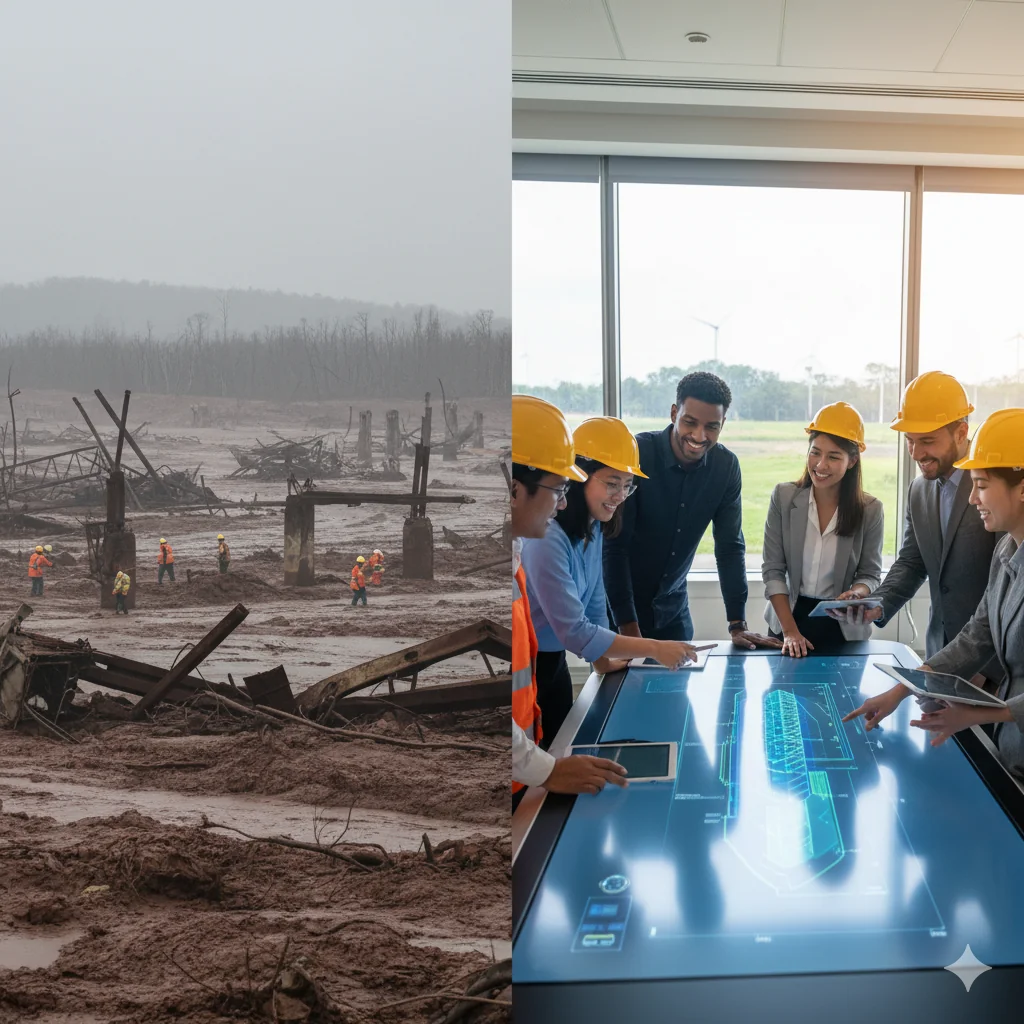
Two tailings dam failures in Brazil — Samarco (2015) and Brumadinho (2019) — changed everything.
Samarco: a wake-up call
In November 2015, the Fundão tailings dam at the Samarco mine (a joint venture of Vale and BHP) collapsed in Mariana, Minas Gerais. The disaster released 40 million cubic meters of tailings, killing 19 people and polluting over 600 km of the Rio Doce. It was, at the time, the worst environmental disaster in Brazil’s history.
Investigations revealed systemic flaws: insufficient monitoring, weak governance, and inadequate risk assessment. Despite promises of reform, less than four years later, tragedy struck again.
Brumadinho: the turning point
On January 25, 2019, a tailings dam at Vale’s Córrego do Feijão mine in Brumadinho collapsed — killing 270 people, most of them Vale employees and contractors. The flow of mud and debris devastated communities and ecosystems downstream.
This time, the public and investor response was immediate and global. Billions were wiped from Vale’s market value. Governments and financiers demanded change. The world’s largest asset managers — including the Church of England Pensions Board and Swedish Council on Ethics for AP Funds — called for a complete overhaul of tailings governance.
Brumadinho didn’t just expose a technical failure — it revealed a failure of governance, ethics, and transparency.
The birth of the Global Tailings Review (GTR)
In early 2019, three organizations came together to lead reform:
United Nations Environment Programme (UNEP)
Principles for Responsible Investment (PRI)
International Council on Mining and Metals (ICMM)
Together, they launched the Global Tailings Review (GTR), an independent process tasked with developing a new global standard for tailings management.
The GTR’s mandate was clear:
Prevent catastrophic failures through a zero harm approach.
Create a global framework that could be applied to all facilities, regardless of location or ownership.
Integrate social, environmental, and technical dimensions of risk management.
Build transparency and trust between mining companies, communities, and investors.
The GTR’s work was led by Dr. Bruno Oberle (then Director General of the International Union for Conservation of Nature, IUCN), supported by an independent expert panel, and informed by extensive global consultations — including public hearings, community workshops, technical reviews, and investor roundtables.
From consultation to consensus — how the GISTM was developed
Over the course of 2019 and 2020, the Global Tailings Review conducted dozens of consultations across continents — from mining hubs in South America and Australia to affected communities in Africa and Europe.
The process included:
Input from 200+ organizations, including mining companies, regulators, engineers, NGOs, and community groups.
Hundreds of technical submissions, detailing best available technologies, risk management frameworks, and governance models.
Public drafts and revisions, ensuring transparency and inclusivity.
Through this dialogue, the GTR team synthesized a framework that bridged engineering science with human rights principles — emphasizing prevention, preparedness, and accountability across the entire lifecycle of a tailings facility.
The final version of the Global Industry Standard on Tailings Management (GISTM) was published in August 2020 — marking a watershed moment for mining governance.
What makes the GISTM revolutionary
The GISTM broke from previous standards by merging technical excellence with social responsibility.
Its key innovations include:
Accountability at the highest corporate level — Every operator must appoint an Accountable Executive responsible for implementation and board-level oversight.
Independent review and verification — Engineers of Record (EoRs) and Independent Review Boards (IRBs) provide checks on facility integrity.
Community involvement — Affected communities must be consulted and included in emergency preparedness and disclosure.
Transparency and disclosure — Operators must publicly report the status, consequence classification, and conformance of each facility.
Lifecycle coverage — The standard applies from site selection through post-closure, not just during operation.
This combination of engineering, governance, and ethical accountability made GISTM the first truly global tailings management framework.
From launch to implementation — early adoption and global impact
The GISTM was officially adopted by all ICMM member companies, representing about one-third of global mining production.
By August 2023, all “extreme” and “very high consequence” facilities were required to meet full conformance.
By August 2025, all remaining facilities must comply.
Many non-ICMM operators, financial institutions, and insurers have also adopted GISTM as a due diligence benchmark, meaning that compliance is becoming a prerequisite for investment and project financing.
In parallel, the Global Tailings Management Institute (GTMI) was established to certify independent auditors and ensure consistent conformance assessment worldwide.
South America: the standard’s testing ground
South America — particularly Brazil, Chile, and Peru — has become the epicenter of GISTM implementation.
Brazil: The country’s major miners, led by Vale and Anglo American, prioritized GISTM compliance for all active and inactive dams, publishing facility-level reports and commissioning independent audits.
Chile: Operators such as BHP and Codelco have integrated GISTM into national frameworks, complementing strict seismic design codes.
Peru: Companies like Antamina and Gold Fields have used GISTM to strengthen community relations and transparency initiatives.
These regional efforts demonstrate the global ripple effect of GISTM — transforming not only engineering practices but also the public perception of mining responsibility.
Lessons from the process — what GISTM teaches us
The creation of GISTM is a model for how complex, high-risk industries can reform themselves when faced with public scrutiny and loss of trust.
Three lessons stand out:
Collaboration works. Bringing together the UN, investors, and industry created legitimacy and balance — a rare achievement in resource governance.
Transparency builds credibility. Public consultation and open data were critical for stakeholder buy-in.
Cultural change is as vital as technical change. The standard’s success depends on shifting corporate culture toward accountability and openness.
The legacy of the Global Tailings Review
Beyond mining, the GISTM serves as a blueprint for global governance reform in high-risk industries. It demonstrates that technical standards can — and should — integrate ethics, social impact, and human rights.
Today, as climate change increases rainfall extremes and seismic risks, the urgency for robust tailings management is greater than ever. The GISTM’s development shows that global alignment and accountability are possible when lives and ecosystems are at stake.
Closing — from tragedy to transformation
The Global Industry Standard on Tailings Management was born from loss — but its legacy is one of transformation.
It redefined how the world thinks about mining waste: not as a byproduct, but as a core element of corporate responsibility. And it showed that when industry, investors, and civil society act together, even the most entrenched systems can evolve toward safety, transparency, and trust.
For mining professionals today, understanding how GISTM came to be isn’t just about history — it’s about understanding where the industry is headed next.
Sources & further reading: Global Tailings Review; UNEP/PRI/ICMM reports; Brazilian agency publications.