

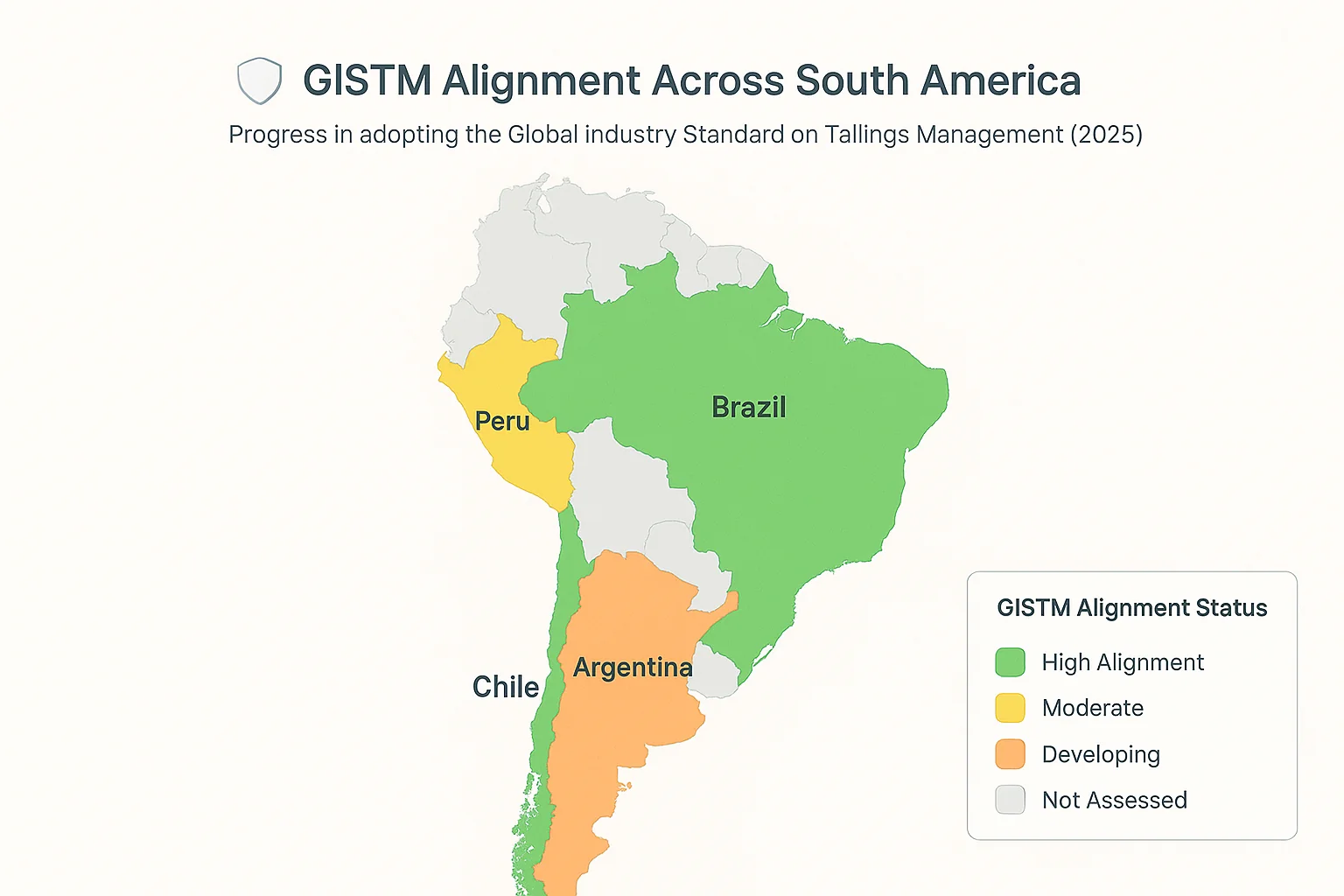
Regional Compliance Map: South America — Aligning with GISTM
//: # (meta: A country-by-country snapshot of how South American jurisdictions and operators are aligning with the Global Industry Standard on Tailings Management (GISTM), plus practical implications for mine teams and project planners.)
Regional Compliance Map: Which South American Jurisdictions Are Aligning with GISTM?
Why a regional map matters
GISTM set a global baseline for tailings safety, but implementation plays out locally. For mining companies and service providers operating across South America, understanding where national regulators, major operators and financiers already align with GISTM (and where gaps remain) is essential for project planning, permitting risk assessment and investor engagement.
Below is a practical, region-focused snapshot — not a legal adoption map — that highlights where activity is concentrated, real examples of corporate disclosure or action, and what operators should prepare for when working in each country.
How to read this snapshot
“High alignment”: clear corporate disclosures, major operators reporting GISTM conformance and active regulatory interest.
“Moderate alignment”: operators moving toward GISTM in practice; regulators are updating guidance or showing interest.
“Developing alignment”: some operator action or guidance exists, but regulatory or disclosure practices are uneven.
Brazil — High alignment (fast corporate movement; strong public attention)
Brazil remains the epicenter for tailings reform. Large national and international operators with Brazilian portfolios have published GISTM conformance statements and disclosure reports, and several have reported high percentages of their TSFs brought into conformance. Major corporate disclosures show that Brazil-based TSFs were a primary focus of remediation and governance changes after high-profile accidents. Operators in Brazil should expect rigorous scrutiny from both investors and national regulators and plan for robust disclosure and remediation timelines. Vale +1
Implication for operators: Prioritize legacy-site triage, Engineer-of-Record appointment, and public disclosure packages — financiers and regulators will demand clear, independently verifiable progress.
Chile — High-to-moderate alignment (operator disclosures + seismic focus)
Chile’s large copper producers have published GISTM-style disclosure reports and technical updates for Chilean TSFs. Because seismic hazard is a dominant design driver, many operators in Chile emphasize conservative design choices, monitoring upgrades and frequent disclosure to regulators and communities. Several major miners (and their Chile operations) provide public GISTM disclosure reports that document conformance steps. angloamerican.com +1
Implication for operators: Expect technical audits focused on seismic loads, instrumentation sufficiency and emergency response readiness — make seismic SOPs and monitoring dashboards a priority.
Peru — Moderate alignment (project-level disclosure; high-altitude issues)
Peru’s major operations have begun publishing GISTM-aligned disclosure reports and conducting independent reviews, especially for high-consequence Andean TSFs. Site teams in Peru commonly face high-altitude hydrology, logistics and community water-dependency issues that shape GISTM implementation. Several Peruvian operations have public tailings disclosure documents useful as practical templates. goldfields.com +1
Implication for operators: Emphasize water-balance updates, supply-chain/logistics planning for retrofits (e.g., thickening/filter plants), and plain-language community water reporting.
Argentina — Developing alignment (operator-level moves; regulatory patchiness)
Argentina hosts a mix of established and smaller mines. Some operators are adopting GISTM practices pragmatically, but regulatory alignment varies by province and projects are often smaller-scale. For many Argentine operations, the pragmatic route is consequence-based triage, modest monitoring packages and staged upgrades so compliance is demonstrable without prohibitive upfront capital. srk.com
Implication for operators: Use documented triage and low-cost monitoring to show near-term risk reduction while you plan longer-term engineering work.
Colombia, Ecuador & Bolivia — Developing to moderate (growing attention)
These countries show growing awareness: operators that are part of global groups largely align with GISTM by corporate policy, and technical consultancies/regulators are increasingly comparing national guidance to the global standard. However, national regulatory regimes and disclosure practices remain heterogeneous. Where projects involve international financiers, expect GISTM-like expectations to be applied as a condition of lending or permitting. srk.com +1
Implication for operators: If you rely on international financing, build GISTM conformance into permitting dossiers from day one — financiers commonly require disclosure and independent reviews.
Uruguay, Paraguay, Venezuela & Guyana — Limited industry tailings footprint; watch for policy shifts
Some countries have limited large-scale tailings activity; where projects exist, GISTM awareness is emerging mostly through industry groups and consultants. These markets are lower-volume but not risk-free; operators should not assume omission of GISTM requirements just because national guidance is limited.
Implication for operators: Even in low-footprint jurisdictions, investors or offtakers may require GISTM-aligned assurances. Prepare minimal disclosure packages and basic monitoring as a cost of financial or commercial access.
Cross-cutting drivers shaping alignment across the region
Major companies & financiers are the accelerant. ICMM members and global miners publish GISTM conformance reports; their practices set expectations for local partners and supply chains. icmm.com
GTMI (Global Tailings Management Institute) will raise the bar. The GTMI’s assurance and audit framework is being rolled out to provide independent conformance assessment — expect this to standardize disclosure and audits across jurisdictions. thegtmi.org +1
Regulatory harmonization is uneven. Regional comparisons show a patchwork of national rules and guidance; this creates asymmetry in permitting speed and required financial assurance. Operators must plan for the strictest plausible interpretation when multi-jurisdictional capital is involved. srk.com
Practical next steps for operators and service providers
Map your portfolio: Build a simple regional compliance matrix (facility / country / consequence classification / estimated GISTM gap / budgeted remediation year).
Assume investor expectations: If your project seeks international financing or an offtaker, treat GISTM conformance as a near-term requirement.
Prepare standardized disclosures: Use GISTM Requirement 15.1 disclosure templates so you can populate investor/regulator requests quickly.
Plan for GTMI audits: Allocate budget for independent reviews and transparent corrective-action plans — early audits reduce rework later.
Localize community engagement: Tailor disclosures and emergency plans to local languages and governance norms across countries (Brazilian state-level nuance differs from Peruvian provincial practice).
Closing — use the regional map as an operational tool
GISTM alignment in South America is real but varied: Brazil, Chile and Peru show the most visible corporate and regulatory activity; other countries are catching up as operators, investors and GTMI expand oversight. For operators, the working assumption should be that financiers and peers expect GISTM alignment — plan projects, disclosures and budgets accordingly.
Sources & further reading: Vale and Anglo American conformance reports; Global Tailings Review; regional regulatory comparisons.