

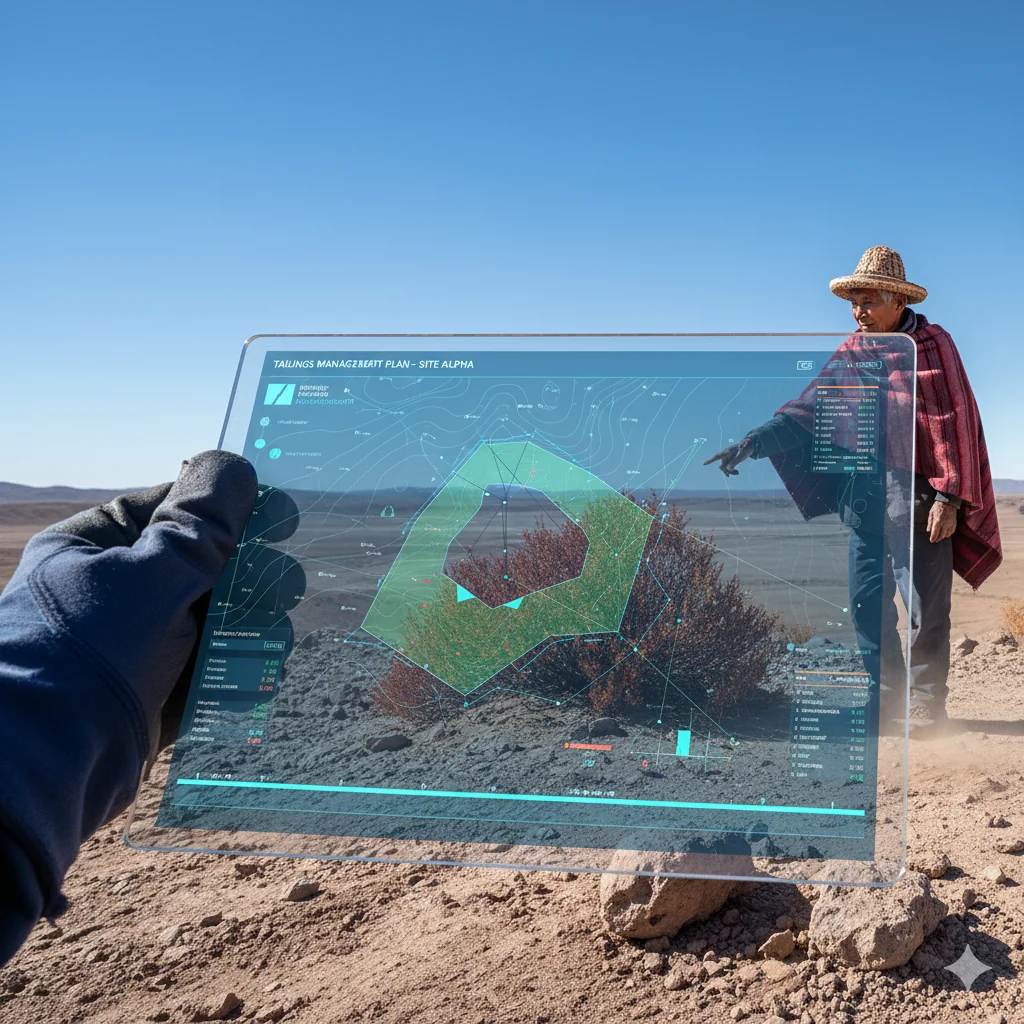
The Community Knows: Why Indigenous Knowledge Should Shape Your Knowledge Base
The Community Knows: Why Indigenous Knowledge Should Shape Your Knowledge Base (Not Just Check a Box)
The engineering team was confident. They’d spent 18 months developing the site characterization: 47 boreholes, 230 lab tests, geophysical surveys, hydrological modeling. The hydrogeological model showed groundwater flowing northeast, away from the river. The Design Basis Report was complete. Construction was ready to start.
Then, during the Free Prior and Informed Consent (FPThe question is: Can you afford not to?
Does your GISTM compliance system capture Indigenous knowledge contributions, or only technical assessments? process, an elder from the downstream Indigenous community said something that made the lead hydrogeologist’s stomach drop:
“That’s not right. During spring melt, water flows the other way—toward the river. It has for as long as our people remember. My grandfather showed me the wet zones that appear every spring in that valley. They’re always in the same places.” me post 9The Community Knows: Why Indigenous Knowledge Should Shape Your Knowledge Base (Not Just Check a Box) The engineering team was confident. They’d spent 18 months developing the site characterization: 47 boreholes, 230 lab tests, geophysical surveys, hydrological modeling. The hydrogeological model showed groundwater flowing northeast, away from the river. The Design Basis Report was complete. Construction was ready to start. Then, during the Free Prior and Informed Consent (FPIC) process, an elder from the downstream Indigenous community said something that made the lead hydrogeologist’s stomach drop: “That’s not right. During spring melt, water flows the other way - toward the river. It has for as long as our people remember. My grandfather showed me the wet zones that appear every spring in that valley. They’re always in the same places.” The team dismissed it initially. “Our model is based on measurements and analysis. Anecdotal observations can’t override technical data.” But something nagged at the hydrogeologist. She reviewed the data. All measurements taken during summer and fall - dry seasons. The model was calibrated to those conditions. They’d never measured spring conditions. They delayed construction for a year to collect spring data. The elder was right. During snowmelt, hydraulic gradients temporarily reversed. The facility design - specifically the seepage collection system - was inadequate for actual seasonal hydrology. That elder’s knowledge, accumulated over generations of observing the same landscape, caught what $2 million of technical studies had missed.
This story (from a real project, details changed for confidentiality) illustrates something GISTM hints at but most operations miss: GISTM Principle 2 requires developing “an interdisciplinary knowledge base” using “approaches aligned with international best practices.” Principle 3 requires using “all elements of the knowledge base - social, environmental, local economic and technical.” But here’s what these principles don’t explicitly say (though they imply): Indigenous and local communities often possess environmental knowledge that technical studies overlook - not because the technical work is wrong, but because it’s temporally and spatially limited in ways that generational observation isn’t. This isn’t about political correctness or checking boxes. It’s about building better, more complete knowledge bases that lead to safer, more effective tailings management. Let’s talk about what that actually looks like. What Indigenous Knowledge Actually Is (And Isn’t) Clearing Up Misconceptions Misconception 1: “Indigenous knowledge is spiritual/cultural beliefs that don’t have scientific validity.” Reality: Indigenous knowledge systems include detailed empirical observations of environmental patterns accumulated over generations. It’s observation-based, tested through repeated experience, and transmitted through structured knowledge systems. Example: Indigenous communities in Canada’s north have detailed knowledge of ice thickness patterns, freeze-up timing, caribou migration routes, plant phenology, weather patterns - all based on centuries of systematic observation. This isn’t mysticism. It’s long-term empirical data collection. Misconception 2: “Indigenous knowledge is useful for anthropological studies but not engineering.” Reality: Indigenous knowledge often contains information directly relevant to:
Hydrology (seasonal flow patterns, flood histories, spring behavior) Geomorphology (erosion patterns, landslide history, terrain stability) Climate (long-term weather patterns, extreme event frequency) Ecology (species presence, habitat connectivity, seasonal changes) Hazards (earthquakes, floods, droughts, fires)
All critical inputs to tailings facility design and risk assessment. Misconception 3: “We can just ask the community to share their knowledge, incorporate it into our reports, and we’re done.” Reality: Effective integration of Indigenous knowledge requires:
Relationship building (not transactional information gathering) Understanding knowledge protocols (some knowledge is not freely shared) Two-way exchange (not just extractive) Ongoing dialogue (knowledge base is living, not static) Benefit sharing (communities should gain from knowledge sharing)
It’s a process, not an event. Misconception 4: “Indigenous knowledge is the same as local knowledge from non-Indigenous communities.” Reality: While local knowledge from any long-term community residents is valuable, Indigenous knowledge systems often have:
Longer temporal depth (multi-generational transmission) Holistic integration (connecting patterns across domains) Place-based specificity (deep knowledge of specific landscapes) Structured transmission (formal knowledge-passing systems)
Both Indigenous and non-Indigenous local knowledge matter. They’re complementary, not competing. The Temporal Advantage: Seeing Patterns Technical Studies Miss The Technical Study Time Window Problem Typical tailings project timeline:
Exploration: 2-5 years Feasibility and design: 2-4 years Construction: 2-4 years
Technical studies happen within these timeframes:
Hydrological measurements: 2-3 years of data Geotechnical investigations: Snapshots from drilling campaigns Environmental baselines: 1-2 years of monitoring Meteorological data: Often from distant weather stations with 20-50 years of records
Total: Direct observations spanning maybe 2-5 years, supplemented by historical datasets that may not be site-specific. Now contrast with Indigenous temporal knowledge:
Direct personal observation: Lifetime (50-80 years) Transmitted knowledge: Grandparents’ observations (add 50-80 years) Oral history: Great-grandparents’ observations (add another 50-80 years) Traditional knowledge: In some cultures, knowledge transmitted across many generations (centuries)
Effective temporal span: 100-300+ years of observations of the same landscape. What This Temporal Depth Reveals Pattern 1: Extreme Events Technical approach: Statistical analysis of historical records estimates 1-in-100 year or 1-in-1,000 year events. Problem: If records span only 50 years, you have no actual observations of 1-in-100 year events. You’re extrapolating. Indigenous knowledge: Might include actual observations or oral history of extreme events that occur outside the technical record. Real example from mine in northwestern Canada: Technical assessment: 100-year flood estimated at 850 m³/s based on 40 years of stream gauge data and regional regression equations. Indigenous community: “That’s not close to the worst flood. In the 1940s (before the gauge), the river was twice as wide as you see today. My grandmother’s cabin was on higher ground than your proposed facility, and it flooded.” Investigation: Found geomorphological evidence (old flood terraces, tree scarring) confirming much larger historical floods. Updated flood estimates: 100-year flood closer to 1,400 m³/s. Result: Major design changes to spillway capacity. Facility that would have been inadequate was redesigned appropriately. Pattern 2: Seasonal Variations Technical approach: Measurements during study period, often concentrated in summer field seasons when conditions allow. Problem: Might miss seasonal extremes or unusual seasonal behaviors. Indigenous knowledge: Observations across all seasons, every year, for generations. Real example (the one from our opening): Spring snowmelt temporarily reverses groundwater flow directions - critical for seepage assessment but missed because all technical measurements occurred during base-flow conditions. Pattern 3: Long-Term Trends Technical approach: Short-term measurements plus climate models for projecting future conditions. Problem: May not capture long-term cyclic patterns or unusual baseline conditions. Indigenous knowledge: Multi-generational observations might reveal that “current conditions” are actually atypical in longer context. Real example from mine in Australia: Technical baseline (2015-2017): Relatively dry conditions, limited groundwater. Indigenous knowledge: “This area used to have permanent springs. They’ve been dry for about 20 years, but our elders remember when water was always there.” Investigation: Revealed that technical baseline was conducted during prolonged drought. Groundwater-dependent ecosystems that appeared non-existent historically existed and likely would recover with normal precipitation. Result: Changed environmental impact assessment and management plans to account for groundwater-dependent ecosystems that weren’t visible during baseline studies. The Spatial Advantage: Landscape-Scale Understanding Technical Studies: Intensive but Localized Typical technical approach:
Boreholes at specific locations (intensive information, small footprint) Study areas defined by project boundaries Focus on areas of direct impact
What this misses: Landscape-scale patterns and connections that extend beyond immediate project area. Indigenous Knowledge: Extensive and Integrated Indigenous landscape knowledge:
Covers large areas (traditional territories often much larger than project footprints) Integrates patterns across space (understands connections) Place-based specificity (knows particular locations in detail)
Real example from mine in northern Canada: Mine’s understanding: Our facility drains to Lake A, 15km downstream. We’re monitoring Lake A for impacts. Indigenous knowledge: “Lake A connects underground to Lake B during high water years through old riverbed that’s usually dry. Lake B is where we fish and where caribou come to drink.” Investigation: Geomorphological assessment confirmed abandoned channel connecting lakes. Hydrological modeling showed Lake B could be affected during wet years even though it wasn’t in the surface water catchment. Result: Expanded monitoring and management to include Lake B. Impact assessment and management plans updated. The key: Indigenous knowledge revealed landscape connectivity that technical studies bounded by project area hadn’t considered. The Ecological Advantage: Species Behavior and Habitat Use Technical Ecological Studies: Snapshots and Sampling Typical approach:
Seasonal field surveys (spring, summer, fall) Sampling protocols (transects, plots, camera traps) 1-2 year baseline to characterize species presence and abundance
What this captures: Species presence during survey periods at survey locations. What this might miss:
Seasonal habitat use outside survey times Movement corridors Critical but infrequent uses (breeding sites used every few years) Behavioral changes in response to disturbance
Indigenous Knowledge: Lifetime Observation of Species What Indigenous hunters, fishers, and land users know:
Where species go during different seasons How species respond to disturbance Critical habitat features that aren’t obvious Population trends over decades Behavioral patterns
Real example from mine in Alaska: Technical caribou study: Conducted surveys during summer and fall migration (when caribou present in area). Identified migration corridor west of proposed tailings facility. Indigenous hunters: “Caribou don’t just migrate through - they calve in the valley north of your facility. Females with calves are very sensitive to disturbance. If you force them to go around your facility during calving season, the calves might not survive the extra distance.” Investigation: Deployed GPS collars on caribou, monitored through calving season (which technical baseline hadn’t covered because of timing and budget). Confirmed: the area was critical calving habitat. Result: Facility location shifted to avoid disrupting access to calving grounds. Alternative location increased project cost by $30M but prevented potentially catastrophic impact to caribou population that Indigenous communities depend on. The Indigenous knowledge was specific, accurate, and covered critical life history stages that the technical study had missed. The Climate and Environmental Change Perspective Technical Climate Projections: Models and Uncertainty Standard approach: Use climate models to project future conditions (temperature, precipitation, extreme events) for facility design and closure planning. Limitation: Models have significant uncertainty, especially at local scales and for extremes. Indigenous Knowledge: Observed Environmental Changes What Indigenous communities notice:
“Winters are shorter than when I was young” “Spring breakup happens earlier now” “Summer storms are more intense than my grandfather described” “Species we used to see are gone; species we never saw are appearing” “The permafrost is thawing where it was always frozen”
This is empirical observation of actual climate change impacts - not modeled projections but lived experience. Real example from mine in Arctic Canada: Climate projections: Models suggest 2-3°C warming by 2080, possible increase in precipitation. Indigenous observations:
Permafrost thawing visibly accelerating (ground slumping in areas that were stable 20 years ago) Lake ice thickness decreasing noticeably over past 30 years Travel season on winter roads becoming shorter and less predictable Species ranges shifting (shrubs encroaching on tundra)
Value for tailings design: Indigenous observations provided ground-truth validation that climate change is already impacting the region in specific ways, not just future projections. Helped calibrate design assumptions to observed trends rather than relying solely on models. Result: More conservative assumptions about permafrost stability in closure design, enhanced monitoring of permafrost conditions, contingency planning for accelerated thaw scenarios. How to Actually Integrate Indigenous Knowledge (Not Just Extract It) The Wrong Approach: Knowledge Extraction What this looks like:
Company schedules “consultation meeting” Asks community to “share traditional knowledge” Takes notes, incorporates some information into reports Thanks community, moves on
Why it fails:
Transactional, not relational Doesn’t respect knowledge protocols Community gets nothing in return Often happens late in project planning (too late to meaningfully influence design) Knowledge is decontextualized (removed from its relational and cultural context)
The Right Approach: Knowledge Co-Production What this looks like: Phase 1: Relationship Building (Before Asking for Anything)
Spend time in community Understand community priorities and concerns Build trust through actions, not just words Demonstrate respect for community governance and protocols
Timeline: Months to years, not weeks. Phase 2: Collaborative Knowledge Development
Joint planning of knowledge gathering (What questions? What methods? Who leads?) Community involvement in technical studies (Indigenous monitors on field crews, community members participating in data collection) Two-way knowledge exchange (technical teams share their knowledge with community, community shares theirs) Documentation respects community protocols (some knowledge may not be appropriate to write down, some may be shared conditionally)
Key principle: Knowledge is co-created, not extracted. Phase 3: Integration Into Decision-Making
Indigenous knowledge influences project design (not just documented in a report) Community representatives involved in design discussions Trade-offs discussed openly (when technical and Indigenous knowledge suggest different conclusions) Decisions show how Indigenous knowledge shaped outcomes
Key principle: Knowledge integration must be demonstrable, not performative. Phase 4: Ongoing Dialogue
Knowledge base treated as living (updated continuously) Community involved in monitoring and adaptive management Long-term relationships beyond initial project approval
Key principle: Indigenous knowledge integration isn’t a project phase - it’s an ongoing commitment. Real Example of Co-Production Done Well Diamond mine in Northwest Territories, Canada: Approach they took: Year 1-2 (before formal project proposal):
Company representatives spent time in communities Attended community events, hunted and fished with community members Built relationships before asking for anything Learned community priorities: environmental protection, employment, respect for land
Year 3-4 (baseline and design phase):
Established Environmental Monitoring Advisory Board with equal Indigenous and company representation Indigenous monitors participated in all field studies Regular community workshops where technical results and Indigenous knowledge both presented Design charrettes where community members and engineers jointly evaluated options
Example of integration:
Technical study identified three potential tailings facility locations Indigenous knowledge revealed one location was near traditional trail used for centuries, had spiritual significance Another location was in area known for poor drainage (consistent with technical findings but added detail) Third location was near berry-picking area but community indicated this was acceptable if access maintained Decision: Selected third location, designed access road to maintain berry-picking access, enhanced monitoring in that area
Year 5+ (operations):
Indigenous environmental monitors employed full-time Quarterly meetings where monitoring results reviewed jointly (technical and Indigenous perspectives) Changes to operations informed by both types of knowledge
Example of adaptive management:
Indigenous monitors noticed caribou behavior changing (avoiding areas they historically used near facility) Company’s technical monitoring hadn’t flagged this (focused on noise and air quality, not behavior) Joint investigation revealed lighting was the issue (caribou avoiding lit areas at night) Modified lighting design (directional, motion-activated, reduced intensity) Caribou use patterns returned closer to normal
Result: Strong community relationships, project operated for 15+ years without major conflicts, environmental performance better than facilities without Indigenous knowledge integration. The key: Genuine partnership, not checkbox consultation. The Free, Prior and Informed Consent (FPIC) Connection GISTM Requirement 1.3 requires: “Where a new tailings facility may impact the rights of indigenous or tribal peoples… work to obtain and maintain Free, Prior and Informed Consent (FPIC).” Most operations focus on the “consent” part - getting agreement to proceed. But the “informed” part requires knowledge sharing in both directions. Communities can’t be “informed” if they’re only presented with technical information that doesn’t connect to their knowledge systems. Companies can’t make informed decisions if they don’t understand Indigenous knowledge about the landscape they’re operating in. FPIC done right inherently involves Indigenous knowledge integration. What FPIC Means for Knowledge Base Development “Free” = Knowledge sharing must be voluntary, not coerced
Don’t pressure communities to share knowledge Respect when communities say certain knowledge is not for sharing Don’t make project approval contingent on sharing specific knowledge
“Prior” = Knowledge integration must happen early, when it can shape decisions
Not after designs are complete Not during regulatory hearings At conceptual stage when alternatives are still open
“Informed” = Both parties must understand each other’s knowledge
Technical teams must understand Indigenous knowledge Communities must understand technical information Translation in both directions (not just translating technical info to community, but translating Indigenous knowledge to technical frameworks)
“Consent” = Ultimately about respecting rights and reaching agreement
Knowledge integration builds trust that supports consent Demonstrates respect for Indigenous knowledge systems Creates foundation for long-term relationship
Real scenario illustrating connection: Mine seeking FPIC for new tailings facility: Early approach (ineffective):
Presented technical designs to community Asked for consent Community said “no” (didn’t trust company, didn’t feel informed)
Revised approach:
Started over with relationship building Invited community knowledge holders to share understanding of landscape Integrated Indigenous knowledge into site selection and design Presented modified designs showing how Indigenous knowledge influenced decisions Community members could see their knowledge reflected in plans
Result: Consent obtained. More importantly, project design was better. Facility reflected both technical expertise and Indigenous landscape knowledge. The Specific Contributions Indigenous Knowledge Makes to GISTM Requirements Let’s map Indigenous knowledge to specific GISTM requirements: Requirement 2.1: Social, Environmental, and Local Economic Context Technical approach: Socioeconomic surveys, environmental baselines, economic studies Indigenous knowledge adds:
Detailed understanding of how communities actually use the land (not just generalized land use categories) Social and cultural values attached to specific places Economic activities that technical surveys might miss (subsistence harvesting, traditional medicines) Historical context (how communities have adapted to past changes)
Requirement 2.2: Site Characterization Technical approach: Drilling, geophysics, lab testing, hydrological measurements Indigenous knowledge adds:
Long-term observations of water behavior (springs, seeps, seasonal variations) Knowledge of terrain stability (locations of historical landslides, areas that are always wet, permafrost distribution) Soil and material characteristics (where different soil types are found, which areas are difficult to traverse) Geomorphology (how landscape has changed, where erosion occurs)
Requirement 2.3: Breach Analysis Technical approach: Modeling of failure scenarios and inundation zones Indigenous knowledge adds:
Detailed knowledge of downstream areas (who lives where, seasonal occupation patterns) Evacuation routes and refuges (high ground locations, traditional safe areas) Community capacity for emergency response Communication networks (how information flows in communities)
Requirement 2.4: Human Exposure and Vulnerability Technical approach: Population counts, infrastructure mapping, exposure modeling Indigenous knowledge adds:
Seasonal presence patterns (communities might be in different locations at different times) Vulnerable populations and their specific needs Social networks and community response capacity Cultural factors affecting evacuation behavior
Requirement 3.1: Climate Change Knowledge Technical approach: Climate models and projections Indigenous knowledge adds:
Ground-truth observations of climate trends (actual observed changes) Ecosystem responses to climate change (species shifts, vegetation changes, permafrost thaw) Extreme weather patterns and frequencies from oral history Traditional indicators of climate patterns
Requirement 3.4: Impact Assessment Technical approach: Environmental and social impact assessment using standard methodologies Indigenous knowledge adds:
Cumulative effects understanding (this project adds to other changes communities have experienced) Valued ecosystem components from Indigenous perspective (might differ from technical assessment) Cultural and spiritual impacts (not captured by standard assessments) Long-term perspective on what “acceptable impact” means
The Challenges: Why This Is Hard Let’s be honest - integrating Indigenous knowledge into technical knowledge bases is challenging. Here’s why: Challenge 1: Different Epistemologies Western technical knowledge: Reductionist, seeks to isolate variables, values quantification, assumes objectivity is possible Indigenous knowledge: Holistic, understands interconnections, includes qualitative understanding, acknowledges observer relationship with observed These aren’t contradictory - they’re complementary. But they require translation. Real challenge: Technical teams sometimes dismiss qualitative Indigenous knowledge as “not rigorous enough.” Indigenous knowledge holders sometimes view technical knowledge as “missing the point.” Solution: Mutual respect and recognition that both knowledge systems have value and limitations. Neither is complete alone. Challenge 2: Knowledge Protocols and Ownership Indigenous knowledge isn’t “free information” to be extracted. Some knowledge:
Is sacred and not appropriate for outsiders Belongs to specific families or individuals Can only be shared in certain contexts Requires permission from knowledge holders May not be written down (oral transmission only)
Real challenge: Companies want documented, written knowledge bases. Some Indigenous knowledge can’t or shouldn’t be documented that way. Solution: Respect knowledge protocols. Some Indigenous knowledge can inform decisions without being written in public reports. Create space for oral knowledge sharing in decision-making processes. Challenge 3: Power Dynamics Reality: Mining companies have resources, technical expertise, legal rights. Indigenous communities have been historically marginalized, may lack resources, often have treaty or Indigenous rights that companies must respect but sometimes resist. This power imbalance affects knowledge sharing:
Communities may be reluctant to share knowledge if they don’t trust it will be respected Companies may give lip service to Indigenous knowledge while prioritizing technical knowledge Disagreements between Indigenous and technical knowledge may be resolved in favor of technical (because “it’s science”)
Solution: Genuine power sharing through governance structures (joint decision-making boards), benefit sharing agreements, and demonstrated respect for Indigenous knowledge in actual decisions (not just reports). Challenge 4: Time and Resources Meaningful Indigenous knowledge integration takes:
Time (years, not months) Resources (supporting community participation, hiring Indigenous monitors, travel for relationship building) Organizational commitment (not just technical team - leadership must prioritize)
Real challenge: Project timelines and budgets often don’t account for this. Indigenous engagement gets squeezed into inadequate timeframes with insufficient resources. Solution: Build Indigenous knowledge integration into project planning from day one, with appropriate time and budget. Recognize this as essential, not optional. Challenge 5: Synthesis and Decision-Making What happens when Indigenous knowledge and technical assessments disagree? Example scenarios: Scenario A: Indigenous knowledge says a location is unsuitable (maybe for cultural reasons). Technical assessment says it’s optimal from engineering perspective. How to resolve? Depends on the nature of the concern. If it’s a rights issue (sacred site, critical traditional use area), Indigenous concerns should prevail. If it’s a technical disagreement, might require deeper investigation of both perspectives. Scenario B: Indigenous observations suggest different hydrology than technical model predicts. How to resolve? Take Indigenous knowledge seriously as hypothesis to test. Conduct additional technical investigation. Often, Indigenous observations are correct and technical models need updating. The key: Create decision-making frameworks that don’t automatically privilege technical knowledge, but also don’t ignore it. Both must inform decisions. Practical Steps: Starting Tomorrow If you’re convinced Indigenous knowledge integration matters, but don’t know where to start: Step 1: Acknowledge What You Don’t Know Honest assessment:
Do we understand what Indigenous communities know about this landscape? Have we asked them in meaningful ways? Have we created space for that knowledge in our decision-making? Have we demonstrated that we respect and use Indigenous knowledge?
Most companies answer “no” or “partially” to all of these. That’s okay - it’s the starting point. Step 2: Build Relationships (Before You Need Them) Don’t wait until you have a specific project need to engage communities. Start building relationships now:
Company leadership visits communities regularly Sponsor community events or initiatives Hire from communities Create opportunities for interaction that aren’t transactional
The goal: When you need to discuss technical issues, there’s already a relationship foundation. Step 3: Create Structures for Knowledge Exchange Don’t rely on ad hoc meetings. Establish formal structures:
Environmental monitoring committees with Indigenous representation Joint technical review processes Indigenous monitor programs (community members employed in monitoring) Regular knowledge-sharing workshops
These structures make Indigenous knowledge integration routine, not exceptional. Step 4: Train Your Technical Teams Most engineers and scientists weren’t trained in Indigenous knowledge integration. Provide training on:
History of Indigenous peoples in your operating area Indigenous rights and FPIC How to respectfully engage with Indigenous knowledge holders How to integrate different knowledge types Cultural awareness and protocols
And hire Indigenous professionals into technical roles. Step 5: Document Integration (But Respect Protocols) Your GISTM knowledge base should show:
How Indigenous knowledge was sought What knowledge was shared (respecting what can/can’t be documented) How it influenced decisions Ongoing processes for knowledge integration
But recognize: The most important knowledge integration might not be written in public reports. Oral knowledge shared in governance processes can inform decisions without being publicly documented. Step 6: Demonstrate Value Through Action Words are cheap. Show respect for Indigenous knowledge through:
Design changes based on Indigenous input Adaptive management that responds to Indigenous observations Benefit sharing that recognizes knowledge contributions Public acknowledgment of Indigenous knowledge in project outcomes
When communities see their knowledge actually shaping decisions, trust grows and knowledge sharing deepens. The Accountability Question As Accountable Executive, ask yourself: Can I honestly say our knowledge base reflects the full understanding of this landscape - technical AND Indigenous? If not, what’s missing? And what am I doing about it? Because here’s the reality: GISTM requires knowledge bases that support safe tailings management throughout the facility lifecycle. A knowledge base that excludes Indigenous understanding of the landscape is incomplete. And incomplete knowledge leads to incomplete risk management. The elder who knew about seasonal groundwater flow potentially saved that project from catastrophic seepage issues. How many other elders, hunters, fishers, and land users have knowledge that could improve your tailings management? The question isn’t whether to integrate Indigenous knowledge. The question is: Can you afford not to?
Does your GISTM compliance system capture Indigenous knowledge contributions, or only technical assessments? [Discover platforms that support knowledge co-production and true interdisciplinary integration]