

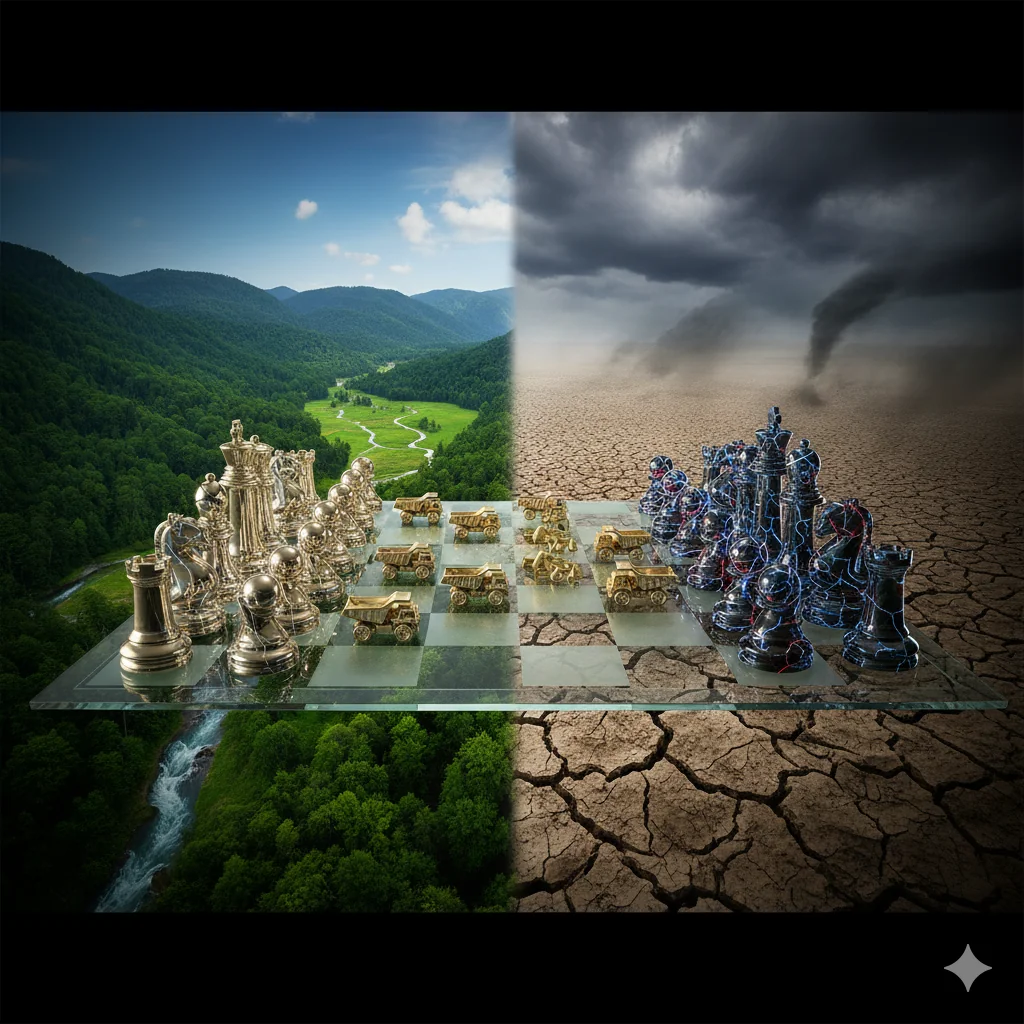
Playing Chess with Climate Change: How Leading Mines Are Future-Proofing Their Tailings Designs
Playing Chess with Climate Change: How Leading Mines Are Future-Proofing Their Tailings Designs
It’s 2024. Your tailings facility was designed in 2005 based on climate data from 1970-2000. The design assumed a 1-in-1000 year storm would drop 180mm of rain in 24 hours. Last month, you got 220mm. In 2021, you got 195mm. In 2018, you got 203mm. Your “1-in-1000 year” event has happened three times in six years. Meanwhile, your facility needs to remain stable for the next 200 years. Maybe longer. Possibly forever. Welcome to the climate change paradox: You’re making decIf you don’t know the answer, it’s time to start playing chess.
Does your GISTM compliance system enable climate-adaptive management, or just document static assumptions?ons today based on yesterday’s data for a tomorrow you can’t reliably predict. The Chess Analogy: Why Climate Adaptation Is Strategic, Not Reactive Good chess players don’t just respond to their opponent’s last move. They think multiple moves ahead, anticipate various scenarios, maintain flexibility, and position themselves to adapt as the game evolves. Bad chess player: “My opponent moved their knight, so I’ll respond to that threat.” Good chess player: “My opponent has three possible strategies developing. I’ll position my pieces so I’m prepared for any of them and can adapt as their intentions become clearer.” Climate change demands the chess player’s mindset, not the checkers player’s. This is why GISTM Requirement 3.1 exists: “To enhance resilience to climate change, evaluate, regularly update and use climate change knowledge throughout the tailings facility lifecycle in accordance with the principles of Adaptive Management.” Notice what it doesn’t say: “Predict future climate and design for it.” Because that’s impossible. Instead, it says: Evaluate what we know, update as we learn more, and use adaptive management to respond. You’re not trying to predict the future. You’re building a system that can adapt to multiple possible futures. The Problem With Traditional Design: It Assumes Stationarity Here’s the foundation of traditional engineering design: Stationarity assumption: The statistical properties of the past will continue into the future. If 100 years of data show the maximum 24-hour rainfall was 200mm, and statistical analysis suggests a 1-in-10,000 year event would be 350mm, you can design for 350mm with confidence. Climate change breaks this assumption completely. The climate system is no longer stationary. The statistics of the past increasingly don’t predict the future. That 1-in-10,000 year event calculated from historical data? It might now be a 1-in-500 year event. Or a 1-in-100 year event. We don’t know precisely - and that uncertainty itself is the problem. Traditional engineering approach:
Gather historical data Perform statistical analysis Design for calculated extreme event Build facility Assume it’s adequate for its design life
Climate-adapted approach:
Gather historical data (knowing it’s increasingly unreliable) Consider climate projections (knowing they’re uncertain) Design for a range of scenarios Build with flexibility to upgrade Monitor performance continuously Update understanding as climate changes Adapt management and infrastructure as needed Repeat steps 5-7 for the facility’s entire life
See the difference? Traditional design is a one-time activity. Climate-adapted design is an ongoing process. What Leading Mines Are Actually Doing: Five Strategic Approaches Strategy #1: Design for Uncertainty, Not Predictions The old approach: Our climate model says rainfall will increase 15% by 2050, so we’ll design for 15% more rain. The problem: What if the increase is actually 25%? Or 10%? What if rainfall increases in winter but decreases in summer? What if intensity increases but total volume stays the same? The chess player’s approach: Design for a range of plausible scenarios, prioritizing flexibility. Real example from a mine in northern Canada: Their tailings facility needed a water management system. Traditional approach would have been: analyze historical data, design spillway for 1-in-10,000 year flood, build it, done. Instead, they:
Analyzed historical data (1950-2020): Maximum annual precipitation 850mm Consulted climate projections from multiple models: Suggested 10-40% increase in precipitation by 2080, with high uncertainty Designed a system with three levels:
Level 1: Handles historical maximum + 20% (immediate construction) Level 2: Handles historical maximum + 40% (designed now, footprint reserved, built if needed) Level 3: Emergency overflow route that safely conveys extreme events even if primary systems overwhelmed
The key insight: They didn’t try to predict which scenario would occur. They designed a system that could adapt as actual climate trends became clearer. Five years later: Precipitation has increased 12% (within their range), Level 1 is handling it fine, and they’ve updated projections showing Level 2 might be needed by 2035. They’re prepared. Strategy #2: The “Reversible Decisions” Framework Chess players avoid committing pieces to positions they can’t escape from. The same principle applies to tailings design under climate uncertainty. Irreversible decision: Building a spillway at a fixed elevation. If climate projections underestimated rainfall intensity, you’re stuck with inadequate capacity. Reversible decision: Building a spillway that can be raised or expanded later. If projections are wrong, you can adapt. Real example from a copper mine in Chile: They were designing a new tailings facility in 2018. Climate projections showed:
Possible 30% decrease in average rainfall (water scarcity concerns) But also possible increase in extreme event intensity (flood concerns) High uncertainty in both projections
Their approach - the “reversible decisions” framework: Irreversible decisions they made:
Footprint and location (chose a site that could accommodate future expansion vertically or laterally) Foundation treatment (went with more robust option that wouldn’t need retrofitting) Emergency spillway location (placed where it could be enlarged if needed)
Reversible decisions they deferred or kept flexible:
Reclaim water system capacity (built for current needs, left room to expand) Freeboard height (started with conservative values, can adjust based on performance) Seepage collection system (phased installation, can densify monitoring if needed)
The result: Core infrastructure assumes climate uncertainty, but operational systems can adapt as actual conditions emerge. Three years in: Rainfall has been below average (water scarcity emerging as bigger concern than flooding). They’ve expanded water reclaim capacity (reversible decision they prepared for) without touching core infrastructure. Strategy #3: The “Climate Stress Testing” Process You can’t predict the future, but you can test your facility against plausible scenarios. Leading mines are running “climate stress tests” - asking: “If climate changes in unexpected ways, where would our facility be most vulnerable?” Real example from an iron ore mine in Australia: Every three years (aligned with their risk assessment cycle), they run their facility through climate stress scenarios: Scenario A: “The Wet Future”
30% increase in total annual rainfall 50% increase in extreme event intensity More frequent consecutive wet years
Questions they ask:
Can our water management system handle this? Would our tailings beach remain stable with higher water content? Could we maintain required freeboard? Would seepage increase beyond collection system capacity? Would access roads be usable during extended wet periods?
Scenario B: “The Dry Future”
25% decrease in average rainfall But longer, more intense dry spells punctuated by extreme events Higher evaporation rates
Questions they ask:
Would dust generation increase beyond control measures? Would desiccation cracking create preferential seepage pathways? Would water availability for operations be adequate? Would vegetation for progressive reclamation survive?
Scenario C: “The Variable Future”
No clear trend in total rainfall But massive increase in year-to-year variability Swings from drought to flood conditions
Questions they ask:
Can our operational protocols handle rapid swings? Would rapid fluctuations in water levels affect stability? Could we maintain consistent closure trajectory with unpredictable conditions?
The key: They don’t try to determine which scenario is “correct.” They identify vulnerabilities across scenarios and prioritize adaptations that reduce risk in multiple futures. Outcome from their 2022 stress test: Identified that their spillway design was adequate for “Wet Future” and “Dry Future” scenarios, but emergency response protocols weren’t adequate for “Variable Future” rapid transitions. They updated EPRPs and operator training without needing infrastructure changes. Strategy #4: Adaptive Monitoring - When Your Instruments Talk to Your Design Traditional monitoring: Collect data, compare to thresholds, trigger actions if exceeded. Climate-adaptive monitoring: Collect data, compare to thresholds, but also update your understanding of climate patterns and adjust future management accordingly. Real example from a gold mine in West Africa: They installed a sophisticated weather station network in 2010, collecting:
Rainfall intensity and duration Temperature and evaporation Humidity and wind Soil moisture
Traditional use: Inform operational decisions (when to move equipment, when flooding risk is high). Climate-adaptive use: Track actual climate trends against projections, update water balance models, adjust management proactively. What they learned by 2023:
Historical data (1980-2010): Average annual rainfall 1,200mm Climate projections (2010): Suggested decrease to ~1,000mm by 2030 Actual trend (2010-2023): Average 1,250mm - increase, not decrease But: Rainfall increasingly concentrated in shorter, more intense events Result: Total volume up slightly, but intensity way up, creating both flood risks and water scarcity (because intense rain runs off rather than infiltrating)
Their adaptation:
Updated water balance model based on actual trends (not projections) Expanded rainwater capture infrastructure (to capture intense events) Increased freeboard temporarily (until they could expand spillway capacity) Modified closure plan (original assumed drier conditions)
The key insight: Their monitoring system detected that climate was changing differently than projected. Because they had an adaptive management framework, they could respond before experiencing failures. Strategy #5: The “Portfolio Approach” to Climate Risk Investment advisors say: “Don’t put all your eggs in one basket.” The same logic applies to climate adaptation. Instead of one “best estimate” design, leading mines are implementing portfolios of adaptation measures. Real example from a nickel mine in Indonesia: They identified climate change as increasing multiple risks:
Risk 1: More intense rainfall — overtopping risk Risk 2: Sea level rise — groundwater table rise — stability concerns Risk 3: Increased cyclone intensity — wind/wave damage to facilities Risk 4: Higher temperatures — increased evaporation — dust control challenges
Traditional approach: Design for each risk independently, implement solutions. Portfolio approach: Implement measures that address multiple risks, prioritize “no-regret” actions, sequence investments as uncertainty resolves. Their climate adaptation portfolio: Tier 1: “No-regret” actions (beneficial regardless of how climate changes)
Increased freeboard (helps with rainfall AND wave action) Improved drainage systems (helps with intense rain AND sea level rise) Dust suppression infrastructure (helps current operations AND future temperature increases) Cost: $12M Implementation: Immediate
Tier 2: “Low-regret” actions (highly likely to be needed, modest cost if wrong)
Spillway capacity expansion (very likely needed based on projections) Monitoring system enhancement (provides early warning regardless of scenario) Beach slope management for stability under wetter conditions Cost: $8M Implementation: Within 5 years, adjusted based on monitoring
Tier 3: “High-value, high-uncertainty” actions (expensive, but critical if scenarios materialize)
Major structural upgrades for extreme sea level rise scenarios Relocation of infrastructure threatened by coastal erosion Backup water sources for extreme drought scenarios Cost: $45M Implementation: Deferred pending better climate understanding, but designed and shovel-ready
The result: They’re spending $20M now (Tiers 1-2) rather than $65M (all tiers). But they’re prepared to spend the additional $45M if monitoring and climate trends indicate it’s necessary. They’re not waiting for certainty - they’re positioning themselves to adapt. The Knowledge Base: More Than a Document GISTM Requirement 2.1 mandates updating your knowledge base at least every five years, and whenever there’s material change to “the social, environmental and local economic context.” Climate change is continuous material change to the environmental context. But here’s where most operations get it wrong: They treat knowledge base updates as document revision exercises. Poor approach:
2020: Produce 500-page knowledge base document 2025: Hire consultant to update it 2030: Repeat
Chess player’s approach:
Knowledge base is a living system, not a periodic report Climate data flows in continuously Understanding evolves based on observed trends Management adapts in response Documentation captures current understanding at any moment
What this looks like in practice: Your climate knowledge base should include:
Historical baseline (pre-industrial to ~2000)
Long-term climate patterns Extreme event statistics Seasonal variability
Recent trends (2000-present)
Observed changes in temperature, precipitation, extremes Comparison to historical baseline Statistical significance of trends
Future projections (present to end of facility life)
Range of scenarios from climate models Uncertainty bounds Confidence levels for different variables
Local observations (your site-specific data)
Weather station records Facility performance under different conditions Deviations from historical patterns
Implications for facility
How changes affect each design element Vulnerabilities under different scenarios Adaptation options and trigger points
But here’s the key: This isn’t a static document. It’s updated continuously as new data arrives. Real example from a coal mine in Queensland: They embedded climate monitoring into their Tailings Management System: Monthly: Operations team reviews rainfall data against historical patterns, flags anomalies Quarterly: RTFE reviews accumulated climate data, compares to design assumptions, updates water balance model if trends emerging Annually: EOR reviews climate trends, assesses implications for design assumptions, recommends adaptations if warranted Every 3 years: ITRB reviews climate adaptation strategy, evaluates whether management is appropriately responsive to changing conditions Every 5 years: Full knowledge base update with formal climate risk assessment The result: Climate isn’t something they think about every five years during knowledge base updates. It’s continuously integrated into operational decision-making. The Water Balance Model: Your Climate Early Warning System GISTM Requirement 5.4 requires developing and maintaining a water balance model “taking into account the knowledge base including climate change.” Most operations treat this as a design exercise: Build a water balance model during design, validate during early operations, update occasionally. Leading operations treat it as a climate monitoring tool. Here’s how: Your water balance model has inputs:
Precipitation (rainfall, snowfall) Evaporation Runoff from catchment Process water additions Seepage losses Reclaim water recovery
And outputs:
Water level in tailings pond Freeboard availability Spillway discharge volumes Seepage to environment
Traditional use: “Given expected climate, how will the facility perform?” Climate-adaptive use: “Given actual climate patterns, how are we performing relative to design assumptions?” Real example from a zinc mine in Ireland: Their water balance model was originally calibrated using climate data from 1970-2000. Design assumed:
Average annual rainfall: 1,100mm Winter rainfall: 65% of annual total Design storm (1-in-1000 year, 24-hour): 145mm
By 2020, actual patterns were:
Average annual rainfall: 1,250mm (+14%) Winter rainfall: 71% of annual total (more concentrated) Largest 24-hour event: 168mm (exceeded design storm that “shouldn’t” happen for centuries)
Their water balance model was increasingly inaccurate because it was calibrated to old climate. Their adaptation:
Recalibrated model using last 20 years of data (2000-2020) instead of 1970-2000 Ran model with updated climate to see implications Discovered: Freeboard that was supposed to be adequate 95% of the time was now adequate only 87% of the time Implemented adaptations:
Temporarily increased minimum freeboard requirements Accelerated spillway upgrade (was planned for 2028, moved to 2024) Enhanced forecasting (3-day weather forecasts now trigger pre-emptive drawdown if major storms predicted)
The key: Their water balance model became a climate change detection system. When modeled performance diverged from actual performance, it signaled that climate assumptions needed updating. Adaptive Management: The Framework That Holds It Together All these strategies - designing for uncertainty, making reversible decisions, stress testing, adaptive monitoring, portfolio approaches - are components of Adaptive Management. But what is Adaptive Management, really? GISTM’s definition (Annex 1): “A structured, iterative process of robust decision-making with the aim of reducing uncertainty over time via system monitoring.” Let’s unpack that: “Structured” = Not ad hoc reactions, but systematic approach “Iterative” = Repeat the cycle continuously, not one-and-done “Robust decision-making” = Decisions that work across multiple scenarios, not optimized for single prediction “Reducing uncertainty over time” = You learn by observing what actually happens “Via system monitoring” = Data-driven adaptation, not guesswork The Adaptive Management cycle for climate:
- Assess (Where are we now?)
What’s our current understanding of climate risks? What are we uncertain about? What climate-related vulnerabilities does our facility have?
- Design (What actions should we take?)
What adaptations address multiple scenarios? What “no-regret” actions should we implement now? What decisions can we defer until uncertainty resolves? What monitoring will inform future decisions?
- Implement (Take action)
Deploy adaptations Install monitoring systems Update procedures and plans Train personnel on new approaches
- Monitor (What’s actually happening?)
Track climate trends Measure facility performance Compare actual vs. predicted Detect emerging patterns
- Evaluate (What did we learn?)
Are climate trends matching projections? Are our adaptations working? What new vulnerabilities have emerged? What uncertainties have resolved?
- Adjust (Update approach)
Refine climate understanding Modify management strategies Trigger contingent actions if thresholds met Update plans and designs
- Repeat (Go back to step 1) This isn’t bureaucracy - it’s disciplined learning. The Closure Challenge: Designing for an Unknowable Future Here’s where climate change creates the most profound challenge: Your tailings facility might need to remain stable for centuries or millennia. You’re designing it now, in 2024, based on climate understanding that’s highly uncertain beyond 50 years. How do you design for closure when you don’t know what the climate will be during the post-closure phase? Leading approaches: Approach #1: Design for Climate Resilience, Not Climate Prediction Instead of: “We predict average temperature will be 2.5°C warmer in 2150, so we’ll design for that.” Do this: “We’ll design a closure configuration that remains stable across a wide range of climate scenarios.” What this means in practice: For water management:
Don’t rely on precise evaporation/precipitation balance Design outlet structures that safely pass extreme events Avoid closure designs requiring perpetual water treatment if climate changes unexpectedly
For erosion control:
Use conservative design storms for erosion protection Design drainage that handles range of intensity scenarios Incorporate redundancy (if primary drainage fails, secondary prevents catastrophic erosion)
For vegetation:
Don’t rely on single species that might not adapt Use diverse native species mix with range of climate tolerances Design substrate that supports vegetation under various moisture regimes
Real example from a uranium mine in Australia: Original closure plan (designed 1998):
Vegetated cover system Design assumed climate similar to historical Selected native species based on current climate No contingency for climate change
Problem by 2015: Some vegetation dying due to increased drought stress; erosion beginning in some areas Revised closure approach (2018):
Substrate: Increased thickness and water-holding capacity (helps plants survive drought) Vegetation: Mix of species - some optimized for current climate, some for projected drier conditions, some for wetter Drainage: Upgraded to handle both more intense rainfall (erosion risk) and extended dry periods (dust risk) Monitoring: Long-term vegetation and erosion monitoring with triggers for intervention
The philosophy shift: From “design for predicted climate” to “design for climate resilience.” Approach #2: Deferred Closure Decisions For very long-lived mines, some closure decisions don’t need to be made now. Chess analogy: You don’t commit your pieces to end-game positions in the opening moves. You maintain flexibility until the board state becomes clearer. Real example from a copper mine in Arizona: Mine life: 60+ years (currently year 12) Closure execution: Likely 2080+ Post-closure monitoring: Probably required for 50+ years after closure Their approach to climate uncertainty: Decisions made now:
Site location (irreversible - done) Overall facility configuration (mostly irreversible - done) Progressive closure opportunities (being implemented)
Decisions deferred to 2040-2050:
Final cover system design (climate will be clearer by then) Specific vegetation species selection (can choose species adapted to actual climate trends) Long-term water management approach (actual precipitation patterns will be better understood)
Decisions deferred to 2070+:
Post-closure monitoring requirements (based on actual facility performance and climate) Long-term maintenance regime (based on observed conditions)
The key: They’re not ignoring these issues. They’re designing a facility that allows these decisions to be deferred until uncertainty reduces. They’ve reserved footprint, maintained flexibility, and documented options - but they’re not locking in specific approaches based on current climate projections that might be wrong. Approach #3: Adaptive Post-Closure Management Controversial take: For high-consequence facilities with climate uncertainty, “perpetual care” might be preferable to “walk-away closure.” Traditional closure paradigm: Design facility so no further intervention needed after closure completion. Climate-adaptive paradigm: Design facility to be stable under expected conditions, with monitoring and contingency plans for adaptive management if climate changes significantly. This doesn’t mean poor design - it means acknowledging uncertainty. Real example from a diamond mine in Canada’s Northwest Territories: Facility classified as “Extreme” (downstream communities) Post-closure phase: Essentially forever (permafrost region with very slow processes) Climate uncertainty: Extremely high (Arctic warming faster than global average) Their approach:
Design most robust closure configuration feasible But acknowledge that permafrost may degrade unpredictably Establish perpetual trust fund for monitoring and adaptive management Define clear trigger points for intervention Pre-design contingency measures if climate impacts exceed design assumptions
Monitoring program includes:
Permafrost temperature and active layer depth (direct climate impact) Settlement and deformation (could indicate permafrost degradation) Seepage quality and quantity (could change with climate) Erosion and vegetation success (climate-sensitive indicators)
Trigger-action framework:
Green zone: Continue monitoring Yellow zone: Increase monitoring frequency, assess trends, prepare contingencies Red zone: Implement pre-designed interventions
The philosophy: Accept that we can’t predict climate perfectly decades ahead. Design the best closure we can, monitor its performance, and adapt if needed. Is this “perpetual care”? Yes. Is it responsible? More responsible than assuming current climate projections are perfect and walking away. The Community Dimension: Climate Justice and Tailings Here’s an uncomfortable reality: Climate change affects downstream communities disproportionately, and they had no role in creating the problem. GISTM Principle 1 requires respecting rights and engaging communities. Under climate change, this takes on new meaning: Communities downstream face:
Increased flood risk if climate increases rainfall intensity Water scarcity if climate decreases precipitation Agricultural impacts from changing seasons Migration pressures if local climate becomes unlivable
Meanwhile, your tailings facility - designed based on historical climate - might become riskier if climate changes unexpectedly. Leading mines are engaging communities on climate adaptation: Real example from a copper-gold mine in Peru: The mine is in an Andean valley. Communities downstream depend on seasonal water flows - glacial melt in dry season, rainfall in wet season. Climate trends:
Glaciers retreating rapidly (less dry-season water) Rainfall patterns shifting (wet season shorter but more intense) Communities already experiencing water stress
Mine’s tailings facility:
Designed assuming historical hydrology Climate change affecting both upstream water availability and downstream flood risk Communities concerned that mine water management could worsen their water stress
Their climate adaptation engagement:
Shared climate monitoring: Installed weather stations accessible to both mine and communities; data publicly available Joint vulnerability assessment: Worked with communities to understand how climate change affects them, not just the facility Integrated water management: Developed water sharing agreements that account for climate variability Coordinated adaptation: Some climate adaptations (like water storage) benefit both mine and communities Transparent communication: Regular updates on how climate trends are affecting facility design and management
The key insight: Climate adaptation can’t be just about protecting the mine. It must consider how climate change affects the entire social-environmental system, including communities. This is what GISTM means by using “all elements of the knowledge base - social, environmental, local economic and technical.” The Role of Your Compliance System: Enabling Adaptive Management Here’s where most compliance tools fail the climate test: They’re designed for static compliance: “Check the box that you updated your knowledge base.” Climate adaptation requires dynamic learning: “Show me how your understanding has evolved and what management changes resulted.” What a climate-adaptive compliance tool should enable: Feature 1: Climate Trend Tracking
Visualize climate variables over time Compare actual vs. historical baseline vs. projections Flag statistically significant trends Link to design assumptions that might be affected
Feature 2: Assumption Tracking
Document all climate-based design assumptions Flag assumptions when actual conditions diverge Trigger reviews when divergence exceeds thresholds Track how assumptions are updated over time
Feature 3: Adaptation Planning
Document climate scenarios considered Map vulnerabilities to scenarios Track “no-regret,” “low-regret,” and “deferred” adaptations Link monitoring data to decision triggers
Feature 4: Knowledge Evolution
Show how knowledge base understanding has changed over time Document what drove changes (new data, new models, actual observations) Connect knowledge updates to management actions Create audit trail of adaptive decision-making
Feature 5: Integration Across Requirements
Link climate knowledge (Req 2.1) to design criteria (Principle 4) Connect monitoring data (Principle 7) to risk assessments (Req 10.1) Tie EPRP updates (Principle 13) to breach analysis changes (Req 2.3) Show how adaptive management touches all aspects of facility lifecycle
The goal: Your compliance system should help you demonstrate adaptive management, not just claim it. The Uncomfortable Questions You Need to Ask As an Accountable Executive, here are the questions that should keep you up at night: Question 1: “My facility was designed 15 years ago. How do I know the climate assumptions are still valid?” Answer: You don’t, unless you’re actively tracking trends. When did you last compare actual climate data to design assumptions? If it’s been more than 2-3 years, you’re flying blind. Question 2: “If climate is changing faster than projections suggested, how quickly would I know?” Answer: Only as quickly as your monitoring and review cycles. If you only update your knowledge base every 5 years, you could be 4.5 years behind emerging trends. Question 3: “What climate change would make my facility’s design inadequate?” Answer: Do you know? Have you tested your facility against plausible scenarios? If you can’t articulate specific thresholds (e.g., “if annual precipitation increases more than 25%, our spillway capacity becomes inadequate”), you haven’t thought through your vulnerabilities. Question 4: “If I needed to adapt our facility design in response to climate trends, how long would it take?” Answer: Years, probably. Which means you need to be looking ahead, not waiting for problems to materialize. Leading indicators (monitoring trends) should trigger planning for adaptations before they’re urgently needed. Question 5: “How am I ensuring my closure design will work under future climate?” Answer: If your answer is “we used climate projections,” that’s not enough. What if projections are wrong? What’s your contingency? Have you built in flexibility? Maintained options? These questions are uncomfortable because they reveal uncertainty. But acknowledging uncertainty is the first step toward managing it. The Bottom Line: Chess, Not Checkers Climate change transforms tailings management from a deterministic engineering problem into a strategic challenge: Deterministic approach: Calculate the 1-in-10,000 year flood, design for it, build it, done. Strategic approach: Understand the range of plausible futures, design for flexibility, monitor continuously, adapt as conditions evolve. This is playing chess with climate change:
You can’t predict your opponent’s exact moves But you can position yourself to respond effectively You maintain flexibility rather than committing to rigid plans You adapt your strategy as the game unfolds You think multiple moves ahead You recognize when the board state has changed and adjust accordingly
GISTM’s climate-related requirements aren’t about predicting the future - they’re about building systems that can adapt to multiple futures. The mines that thrive over coming decades won’t be the ones with the most sophisticated climate models. They’ll be the ones with:
Robust designs that work across scenarios Monitoring systems that detect emerging trends Decision frameworks that respond appropriately Organizational cultures that embrace adaptation Stakeholder relationships built on transparency about uncertainty
Climate change is the ultimate test of Adaptive Management. The question isn’t whether you’re compliant with climate-related requirements. The question is: If climate changes in unexpected ways over the next 50 years, is your facility positioned to adapt? If you don’t know the answer, it’s time to start playing chess.
Does your GISTM compliance system enable climate-adaptive management, or just document static assumptions? [Discover tools built for dynamic learning in an uncertain future]