

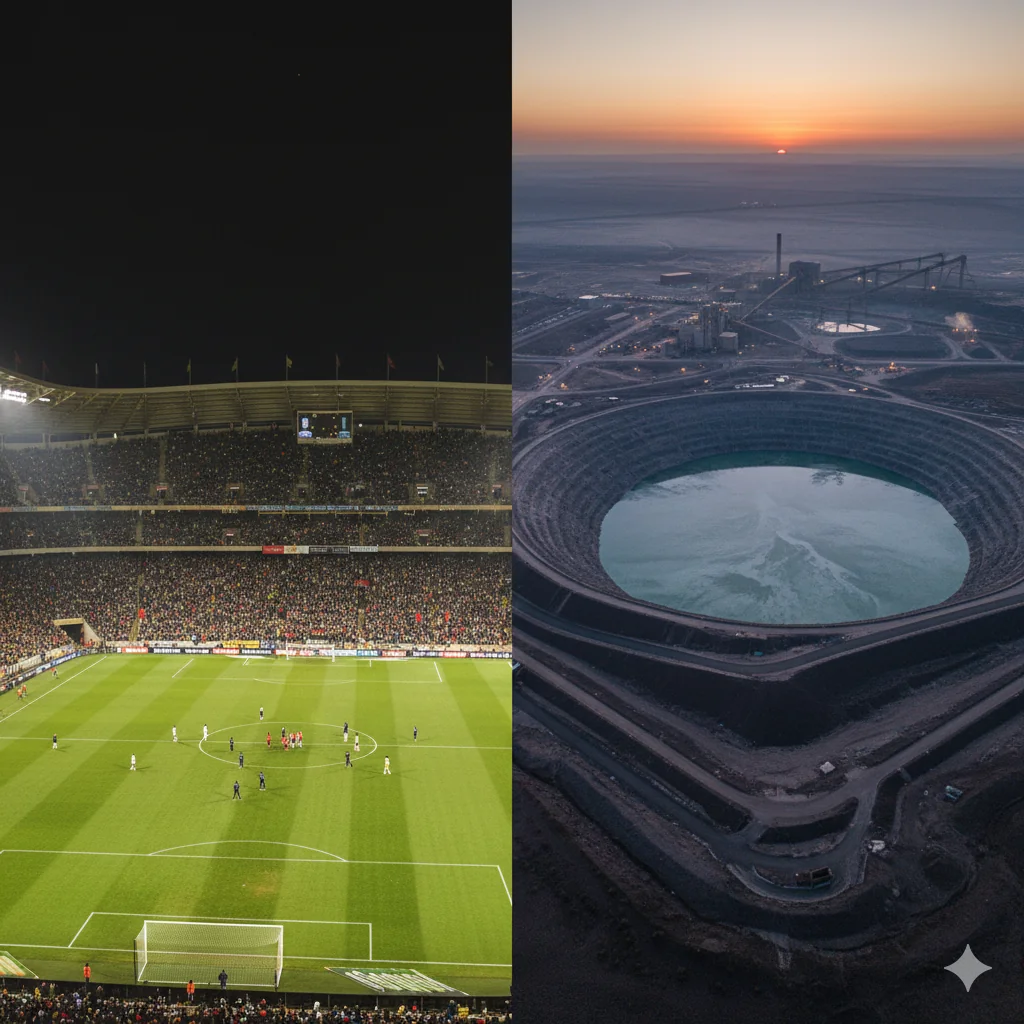
From Catastrophe to Comeback: What Football Stadium Design Can Teach Us About Tailings Facility Planning
From Catastrophe to Comeback: What Football Stadium Design Can Teach Us About Tailings Facility Planning
It’s match day at a modern stadium. 60,000 people pour through the gates, completely unaware that nearly every aspect of their experience—from the width of the concourses to the number of exit doors to the placement of concession stands—has been engineered arounDoes your GISTM compliance system help you visualize consequences, not just track requirements? a single question: “What happens if we need to evacuate?“ve me post 2From Catastrophe to Comeback: What Football Stadium Design Can Teach Us About Tailings Facility Planning It’s match day at a modern stadium. 60,000 people pour through the gates, completely unaware that nearly every aspect of their experience —from the width of the concourses to the number of exit doors to the placement of concession stands —has been engineered around a single question: “What happens if we need to evacuate?” Now imagine this: Your tailings facility sits in a valley. Downstream are communities, infrastructure, maybe a river that supplies drinking water. The engineering is sophisticated, the monitoring is comprehensive, the maintenance is meticulous. But here’s the question that keeps the Accountable Executive awake at night: “What happens if everything goes wrong?” Welcome to consequence-based design thinking —and why the world of sports venue architecture has surprisingly relevant lessons for tailings facility management. The Hillsborough Shift: When Design Philosophy Changed Forever On April 15, 1989, 97 people died at Hillsborough Stadium in Sheffield, England, during an FA Cup semi-final. It remains one of the worst disasters in British sporting history. The tragedy wasn’t caused by structural failure. The stands didn’t collapse. The stadium didn’t catch fire. What failed was the consequence management system - crowd control, communication, emergency access, and evacuation planning. The aftermath revolutionized stadium design worldwide. But more importantly, it fundamentally changed how engineers think about high-consequence facilities. The lesson: Technical integrity is necessary but insufficient. You must design for the consequences of failure, not just against the probability of failure. Sound familiar? It should. This is exactly the philosophy underpinning GISTM’s consequence classification approach. Consequence Classification: The Stadium Designer’s Mindset When architects design a stadium, they don’t ask: “How do we make sure nothing ever goes wrong?” That’s impossible. Instead they ask: “How do we minimize harm when things inevitably don’t go according to plan?” This is consequence-based thinking, and it involves three levels: Level 1: Know Your Exposure Stadium equivalent: Capacity planning and occupancy limits
How many people will be here? Where exactly will they be? What are their characteristics? (families with children, elderly, mobility-impaired) What are their egress routes?
Tailings equivalent: Population at risk assessment (Requirement 2.4)
Who lives, works, or travels downstream? Where exactly are they in relation to potential flow paths? What makes them vulnerable? (sleeping hours, limited mobility, language barriers) What’s their exposure in different failure scenarios?
The parallel: Both require honest, unflinching assessment of who could be harmed. Stadium designers count every seat. Tailings engineers should know every home, workplace, school, and road in the inundation zone. Level 2: Design for Multiple Scenarios Stadium equivalent: Emergency planning for different event types
Fire in the stands (vertical evacuation needs) Pitch invasion (crowd control barriers) Structural concerns (horizontal evacuation routes) External threat (lockdown procedures)
Tailings equivalent: Credible failure modes and breach analysis (Requirement 2.3)
Slope failure scenarios Overtopping events Foundation issues Seismic triggering
The parallel: You can’t design for every possible scenario, but you can identify credible ones and ensure your design addresses each. Stadium designers don’t plan for meteor strikes, but they do plan for fires, earthquakes, and crowd surges. Similarly, tailings facilities focus on credible failure modes - technically feasible scenarios given materials, configuration, and conditions. Level 3: Layer Your Defenses Stadium equivalent: Multiple safety systems
Primary: Robust structural design, proper capacity limits Secondary: Stewards, CCTV monitoring, crowd control measures Tertiary: Clear signage, multiple exit routes, emergency lighting Final: External emergency services, evacuation plans, medical facilities
Tailings equivalent: ALARP principle and defense in depth
Primary: Conservative design criteria, appropriate factors of safety Secondary: Monitoring systems, operational controls, trigger action response plans Tertiary: Emergency preparedness, community warning systems Final: Emergency response capabilities, long-term recovery planning
The parallel: Neither system relies on a single point of protection. When you attend a major event, you’re surrounded by overlapping safety systems, most of which you never notice. The same should be true downstream of a tailings facility. The “Extreme” Paradox: Why Maximum Consequence Drives Minimum Risk Here’s something that confuses people about GISTM’s consequence classification: A facility classified as “Extreme” isn’t necessarily unsafe. It’s just honestly acknowledging: “If something went wrong here, the consequences would be severe.” Think about it through the stadium lens: Wembley Stadium in London holds 90,000 people. A small local stadium might hold 5,000. Which gets more rigorous safety requirements? Obviously Wembley - not because it’s more dangerous, but because the consequences of failure are larger. The same stadium fire that would be tragic at a small venue becomes catastrophic at a massive one. So Wembley has:
More exit routes (proportionally and absolutely) More sophisticated monitoring and communication systems More stringent structural requirements More detailed emergency planning More frequent safety reviews
This is exactly how GISTM’s consequence classification works. A tailings facility with 1,000+ people in the potential inundation zone gets classified as “Extreme.” Not because it’s currently dangerous, but because if a failure occurred, the consequences would be extreme. Therefore:
Design criteria must be more conservative (1/10,000 year seismic events) Monitoring must be more comprehensive Review must be more frequent (ITRB required, DSR every 5 years) Emergency planning must be more detailed Disclosure requirements are more extensive
Design Philosophy: Planning for Partial Failures Modern stadium design includes something called “progressive collapse prevention.” The idea: if one structural element fails, the failure shouldn’t cascade through the entire structure. Real example: After a 2011 incident where a section of railing failed, causing injuries, stadium codes were revised. Now, if one railing section fails, adjacent sections must be designed to temporarily carry the additional load until repairs can be made. The system degrades gracefully rather than failing catastrophically. This maps directly to GISTM’s requirements around: Brittle vs. Non-Brittle Failure Modes (Requirement 4.6) Stadium thinking: Some failures happen suddenly (structural collapse), others develop gradually (concrete degradation). Design differently for each. Tailings thinking:
Brittle failures (like liquefaction) happen suddenly with little warning — Require conservative design criteria to prevent occurrence Non-brittle failures (like slope creep) develop gradually — Can use Observational Method with monitoring and response protocols
The lesson: Not all failure modes are equal. Different threats require different design philosophies. The Observational Method: Stadiums Do This Constantly Every major stadium has:
Settlement monitoring on foundations Crack monitoring on concrete structures Deflection monitoring on roof structures Corrosion monitoring on steel elements
They set threshold levels: green (all good), yellow (increased monitoring), red (immediate action). Sound familiar? This is exactly what TARPs (Trigger Action Response Plans) do for tailings facilities. The stadium advantage: They can see the performance data in real-time and adjust. If a section of roof is deflecting more than expected but still within safe limits, they can increase inspection frequency, investigate causes, and plan interventions before reaching critical thresholds. The tailings equivalent: Modern monitoring systems with piezometers, inclinometers, settlement monuments, and survey points provide real-time performance data. The Observational Method (Requirement 7.2) means actively using this data to confirm design assumptions and trigger responses when performance deviates. Emergency Planning: The Evacuation Mindset Here’s where stadium design gets really interesting for tailings professionals: Every Stadium Has an Evacuation Time Target Regulations typically require that stadiums can evacuate fully within 8 minutes. Not 8 minutes and 30 seconds. Eight minutes. This drives:
Number and width of exit routes Stair dimensions and handrail spacing Door swing directions and locking mechanisms Corridor widths and intersection designs Signage visibility and redundancy
Everything is designed backwards from that 8-minute target. Now apply this to EPRP development (Requirements 13.1-13.4): Do you know your evacuation time requirements?
How long between detection of a problem and potential failure? How long to issue warnings to downstream communities? How long for people to evacuate to safe zones? What’s your margin for error?
Most importantly: Does your design give you enough time? A facility designed with steeper slopes and lower factors of safety might progress from “concern” to “failure” in hours. A more conservative design might provide days or weeks of warning. This time buffer is part of consequence management. The “Pre-Event” Strategy Modern stadiums don’t wait for emergencies to establish evacuation routes. They’re designed into the architecture:
Concourses are sized for emergency egress, not just normal flow Multiple exits are distributed around the entire venue Routes are clearly marked and regularly tested Staff are trained on evacuation procedures before every event
Tailings equivalent:
Communities downstream should know their evacuation routes now, not when alarms sound Multiple safe zones should be identified and communicated Routes should be maintained (not blocked by development) Drills should happen regularly (Requirement 13.3 mandates simulations at least every 3 years for facilities with potential loss of life)
The lesson: Emergency response planning isn’t something you create after a facility is built. It’s integrated into the design from day one. The Role of Real-Time Information Walk into any modern stadium control room and you’ll see:
CCTV feeds from hundreds of cameras Crowd density monitoring systems Weather radar feeds Communication systems with emergency services Direct links to public transportation Social media monitoring for crowd sentiment
Why? Because managing consequences requires real-time situational awareness. Now look at a sophisticated tailings facility:
Real-time piezometer readings Automated settlement monitoring Weather station data and forecasts Seismic monitoring systems Visual inspection via drones or cameras Integration with early warning systems
The parallel: Both systems recognize that preventing catastrophe requires knowing what’s happening right now, not what happened during last month’s inspection. This is why GISTM emphasizes comprehensive monitoring (Principle 7) with appropriate frequency of data collection and analysis (Requirement 7.4). Stadium operators don’t check crowd conditions once a week - they monitor constantly. Critical tailings facilities should have similar vigilance appropriate to their risk profile. Adaptive Design: The Wembley Arch Example When Wembley Stadium was rebuilt (2003-2007), engineers included a 133-meter-high arch primarily designed to support the roof. But here’s the clever part: the arch is instrumented with sensors that continuously monitor:
Temperature (which causes expansion/contraction) Wind loads Structural stresses Settlement at support points
This data feeds back into structural models, allowing engineers to verify that the arch is performing as designed. If performance deviates from predictions, they know immediately and can investigate. This is Adaptive Management (Requirement 3.1) in action. For tailings facilities facing climate change uncertainty:
Design assumptions about rainfall might change Seismic hazard understanding might evolve Downstream development might alter consequence classification Material properties might prove different than expected
The Adaptive Management approach:
Design based on best current knowledge Monitor performance and context continuously Update understanding as new data arrives Refine management strategies accordingly Repeat
The Wembley arch doesn’t get rebuilt every time an assumption changes —management adapts. Similarly, tailings facilities should have built-in flexibility (Requirement 4.2’s proof-of-concept for upgrading) and regular review cycles (DSR every 5-10 years) to adapt to new knowledge. The Psychology of Safety: Making the Invisible Visible Stadium designers understand something crucial: people need to feel safe, not just be safe. That’s why:
Exit signs are everywhere (even when exits are obvious) Safety announcements happen before events Stewards in high-visibility jackets are positioned throughout Emergency procedures are printed on tickets
The psychology: When people can see that safety is being managed, they trust the system. When safety is invisible, they worry. For tailings facilities, this translates to GISTM’s public disclosure requirements (Principle 15): What stakeholders should see:
Consequence classification (they deserve to know) Summary of risk assessments and mitigation Emergency response plan summaries Regular performance monitoring results Independent review schedules and findings
Why it matters: Communities downstream aren’t irrational for worrying about tailings facilities. Making safety management visible — showing that risks are identified, monitored, and controlled — builds justified confidence. The stadium comparison: You don’t hide evacuation routes or pretend emergencies can’t happen. You make preparedness visible, which actually reduces anxiety. Multi-Criteria Decision Making: More Than Just Engineering When choosing a location for a new stadium, designers consider:
Technical: Ground conditions, seismic risk, drainage Social: Community impact, accessibility, noise Environmental: Habitat impacts, water management, air quality Economic: Construction costs, operating costs, economic benefits Cultural: Heritage impacts, visual impact, community identity
No single criterion dominates. The best location emerges from balancing all factors. This is exactly what GISTM’s multi-criteria alternatives analysis requires (Requirement 3.2). For new tailings facilities, consider:
Technical: Site conditions, stability, constructability Social: Community impacts, displacement, livelihoods Environmental: Water quality, ecosystems, biodiversity Economic: Capital costs, operating costs, closure costs Cultural: Heritage sites, sacred areas, traditional territories
The stadium lesson: The “best” technical solution might be terrible when social and environmental factors are considered. True optimization requires considering all dimensions simultaneously. The Ownership Model: Accountability That Lasts Here’s something interesting: When a stadium hosts an event, responsibility is crystal clear:
The venue operator is accountable for the facility The event organizer is accountable for the event The local authority oversees compliance Emergency services have defined response roles
Everyone knows who’s responsible for what, and there’s no ambiguity when something goes wrong. Compare this to tailings facilities:
Who’s accountable when ownership changes? What happens when mines are sold to junior companies? How do you ensure capability when management changes? Who’s responsible after mine closure?
GISTM addresses this through:
Clear definition of the Accountable Executive (Requirement 8.4) who remains answerable regardless of organizational changes Due diligence requirements for acquirers (Requirement 10.8) Financial provisions for closure that outlast operations (Requirement 10.7) Design for perpetual stability, not just operational life
The lesson: Accountability must be clear, documented, and survive organizational changes. Stadium operators can’t say “we’re not responsible anymore because we hired a new manager.” Neither can mining companies. Testing Under Pressure: The Value of Simulations Every major stadium conducts evacuation drills. Not just training exercises — full-scale simulations with:
Real-time decision making Communication challenges Coordination with external services After-action reviews to identify improvements
Why bother? Because theoretical plans fail under real-world pressure. Simulations reveal:
Communication breakdowns Unclear roles and responsibilities Resource shortfalls Coordination failures Training gaps
For tailings facilities (Requirement 13.3):
Emergency simulations should happen at least every 3 years They should involve all stakeholders (operations, communities, emergency services) They should be realistic enough to stress-test the system They should include after-action reviews that drive improvements
The stadium insight: Nobody waits for an actual emergency to discover their evacuation plan doesn’t work. Don’t wait for a tailings crisis to test your EPRP. The Long View: Designing for Decommissioning Here’s where stadium design and tailings facilities diverge - and it’s instructive: Stadiums are designed to be dismantled. The deconstruction plan is often drafted before construction begins. Materials are selected partly based on recyclability. Connections are designed for future disassembly. Tailings facilities are designed for perpetuity. But here’s the problem: many were designed when “closure” meant “stop operating and walk away.” GISTM’s closure requirements (Requirement 5.7, Principle 6) flip this:
Closure must be designed from the start Design must demonstrate feasibility of safe closure Financial provisions must cover perpetual care if needed Progressive closure should happen during operations
What mining can learn from stadium decommissioning:
Plan the end from the beginning Design for the long-term state, not just operations Ensure resources are available for decommissioning Don’t leave future generations with unfunded liabilities
Knowledge Transfer: The Commentary Booth Principle In major stadiums, there’s often a historian or long-time commentator who knows the venue intimately - its quirks, its history, why certain things are done certain ways. When renovations happen or problems arise, this institutional knowledge is invaluable. Modern stadiums document this knowledge systematically. For tailings facilities, this is the knowledge base (Principles 2 and 3):
Site characterization data Design assumptions and their rationale Construction records and as-builts Performance history and monitoring trends Decisions made and why Lessons learned from incidents
The critical moment: When the EOR changes (Requirement 9.5), or the RTFE moves on, or ownership transfers, this knowledge must transfer completely. The stadium lesson: Don’t rely on institutional memory stored in people’s heads. Document everything. Make knowledge transfer formal and comprehensive. The Bottom Line: Consequence-Aware Design The fundamental insight from stadium design is this: You don’t eliminate all risk. You design for the consequences when risks materialize. This means:
Know exactly who or what could be harmed Design based on the severity of potential consequences Layer multiple protective systems Plan for degraded performance, not just perfect function Make response capability proportional to potential consequences Test your systems before you need them Maintain vigilance throughout the facility lifecycle
Every sports fan who’s attended a major event has benefited from this philosophy without knowing it. The stadium didn’t collapse. The crowd flowed smoothly. Emergencies were handled professionally. They went home safely. That’s not luck. That’s consequence-aware design. For tailings facilities, GISTM embeds this same philosophy:
Consequence classification drives design criteria (Principle 4) Multiple review layers provide oversight (Principle 10) Emergency planning is mandatory (Principle 13) Public disclosure ensures transparency (Principle 15) Adaptive management responds to changing conditions (Principle 3)
Bringing It Home: Your Compliance System’s Role A sophisticated GISTM compliance platform should help you think like a stadium designer: Consequence mapping:
Visual representation of downstream exposure Integration of breach analysis with population at risk Updates when downstream conditions change Links between consequence classification and design criteria
Scenario planning:
Track different credible failure modes Document mitigation measures for each Test emergency response scenarios Maintain drill records and improvement actions
System integration:
Connect monitoring data with trigger levels Link TARP activations with incident response Integrate stakeholder communication protocols Coordinate internal and external response capabilities
Knowledge management:
Centralize design assumptions and rationale Track how understanding evolves over time Document decisions and their basis Ensure smooth transitions when personnel change
The Question That Matters When you design a stadium, you imagine it full of people and ask: “Can we get everyone out safely if we need to?” When you design a tailings facility, you should look downstream and ask: “If the worst happened, would our planning, our systems, our preparations give people the best possible chance?” The technical engineering matters enormously. But it’s not enough. You need:
Honest assessment of consequences Design appropriate to those consequences Systems that work under pressure Plans tested before they’re needed Transparency that builds trust Vigilance that never sleeps
Football stadiums figured this out decades ago. The mining industry is catching up. GISTM provides the framework. The question is: Are you using it to design facilities with the same consequence-aware rigor as the stadium where you might watch a match this weekend? Because the people downstream deserve nothing less.
Does your GISTM compliance system help you visualize consequences, not just track requirements? [Discover how modern tools bring consequence-aware thinking to tailings management]